Battlefields of the Napoleonic wars
Photographing battlefields of the Napoleonic era, two centuries later, is not easy because they evolved as the landscapes of the countryside but also as our cities...
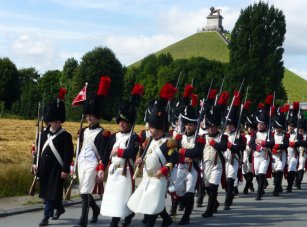

Some have remained in a state close to that fighters roamed at the time: either because they have been protected (Waterloo) or because their rurality has avoided them, for now, a too visible transformation (Marengo, Austerlitz, Eckmühl, Friedland, Champaubert...). Of course, some electrical or telephone poles and wires, some antennas or satellite dishes, some cars or tractors, some advertisement billboards were added to those places (one must move with the times, even in the countryside); but the photo retouching softwares can often remove them, so we can see before us a state close to that as valiant veterans, and the Emperor himself, saw.
But alas it is not of same everywhere. Cities, especially, have been greatly transformed, sometimes even in their historical center. Some quintupled or tenfold of size (Alessandria, Mantua, Vienna and its surroundings, Leipzig, Dresden, Vitoria, Laon, Montereau ...), others were disfigured during subsequent conflicts (Reims during World War I, Ulm, Dresden and Leipzig during World War II). Housing estates have flourished even in the countryside (Wagram, Vauchamps); when this is not one of those awful commercial areas, over several dozen acres, that has settled over much of the battlefield (La Favorita near Mantua, Mont-St-Pierre at Tinqueux near Reims). Then, a church, a few walls, a piece of land are all that remains to be seen... for how long?
We have not visited all the Napoleonic battlefields, far from it. Our next years will be devoted to enriching the iconography. Then some younger persons will take over from us, we hope so, to complete this work. Because images never die.
Enjoy your visit!
 ARCIS-SUR-AUBE (20 and 21 March 1814)
The battlefield is located on the left bank of the river Aube, therefore to the south of it. It stretches in a semi-circle around Arcis: Villette to the west (on the road to Méry-sur-Seine), Nozay to the south-west and Mesnil-la-Comtesse to the south-east (on both sides of the road to Troyes), Torcy-le-Grand and Torcy-le-Petit to the east (towards Brienne). The land is absolutely flat.
A single bridge, in Arcis itself, makes it possible to reach the right bank of the Aube. During the battle, a temporary bridge had been thrown over the river near Villette.
Arcis-sur-Aube: aerial view from the road to Troyes, south of the city
Arcis-sur-Aube: Saint-Etienne church, downtown [48.53667, 4.14197]
Arcis-sur-Aube: the castle [today the City Hall]
Arcis-sur-Aube: the bridge over the river Aube
The river Aube
The battlefield, south of Arcis, towards Villette
The river Barbuise, west of the battlefield
Dommartin
Méry-sur-Seine
Mesnil-la-Comtesse: the village and its surroundings
Nozay: the village and the battlefield in front of it
Plancy-l'Abbaye
Saint-Etienne-sous-Barbuise: aerial view
Torcy-le-Grand , Torcy-le-Petit and Vinets , east of Arcis
Villette


 ARCOLE (15 to 17 November 1796)
The famous Arcole bridge spans the Alpone torrent, which flows in a north-south direction before going to throw itself into the Adige river, a few kilometers south-east of Ronco all'Adige. The village is entirely located to the east of the Alpone, therefore on its left bank. Visited in summer, the level of the latter was very low, but in mid-November 1796 it was certainly not the same!
The bridge itself still retained its two piers in 2013, but its deck, made of wood during the battle, was concreted (as were the banks). Alas, during our visit in 2016 it had been replaced by a bridge with a single arch in reinforced concrete and corten steel, no longer having anything to do with the historic bridge known to Bonaparte and Augereau... The surrounding marshes have dried up for a long time, and all the land is now cultivated.
Albaredo
Arcole: the bridge [45.35728, 11.27773] in 2012-2013, seen from the eastern bank and from the western bank
Arcole : the bridge in 2016, seen from upstream and downstream
Arcole: the outlet of the bridge on the left (east) bank held by the Austrians and on the right bank (west, held by the French) . At the time they were swamps
Arcole: obelisk erected in 1810 at the outlet of the bridge on the right bank, to the west, and the commemorative plaques affixed on it
Arcole: the outlet of the bridge on the eastern bank of the river Alpone and the village
Arcole: the Alpone river, upstream the bridge and downstream , and several kilometers further its confluence with the Adige river
Arcole: the Palazzo Ruffo and a vintage house
Caldiero : the village and the Monte Rocca
Colognola
The locality named Porcil
Ronco all'Adige: Napoléon Bonaparte's headquarters during the battle and the following day
San Bonifacio
San Giacomo
San Martino
San Michele-extra
San Stefano di Zimella
Villafranca di Verona: Napoléon Bonaparte's headquarters the evening before the battle
 ASPERN-ESSLING (21 and 22 May 1809)
The Battle of Aspern-Essling is called Battle of Aspern by German speakers and Essling by French speakers. The violent and deadly clashes took place in and around these two villages, north of the Danube [they are now part of the 22nd district of Vienna], as well as in Gross-Enzersdorf, a little further east. Demographic and urban developments mean that unfortunately, at the start of the 21st century, it is very difficult for visitors to imagine themselves on the battlefield, and it is necessary to move a few hectometers north of Eßlinger Hauptstraße to find a few remaining fields between residential areas.
Remains the island of Lobau, further south, between the Danube [nowadays canalized] and an arm of it, which will delight the Napoleonic hiker or cyclist. This area of four by three kilometers, made of woods and swamps, crossed by roads and dirt paths, has remained in a state close to that experienced by French soldiers, or the famous writer Honoré de Balzac who visited it in 1835. The Austrians did things well on the occasion of the centenary commemoration in 1909, since several stone markers were erected at places affected by the preparations for the battle, or the retreat which followed it. The island is now classified, so we can be optimistic for the future.
Aspern: the church
Aspern: the cemetery and the Sebastian chapel
Aspern: the Lion, sculpture honoring the Austrian fighters
Aspern: obelisk in memory of the Austrian soldiers
Bisamberg
Breitenlee , where Archduke Charles established his headquarters
Battlefield, north of the Lobau
The river Danube (© 2014 Michèle Grau-Ghelardi)
Essling: the church and the castle , on both sides of main street
Essling: the Granary [48.21597, 16.52416] where the French have valiantly withstood the Austrian assaults
Gross-Enzersdorf: the village , the church and the battlefield between Essling and Gross-Enzersdorf
Kagran: inn havin hosted Napoléon
The Lobau Island: landscapes
The Lobau Island: memorial stones : Napoleon's headquarters , powder reserve , French bridgehead , French cemetery
The plain of Marchfeld
Markgrafneusiedl: Archduke Charles' headquarters
Süssenbrunn
 AUERSTAEDT (14 October 1806)
Many thanks to Mrs. Christiane Deshaies-Da Luz for the photos she provided us to put on the website.
Auerstaedt [now Auerstedt] is a village located some thirty kilometers north of Jena, a German town in northern Thuringia, where another Napoleonic victory took place on the same day. The battlefield, which is located to the north and east of the village, is moderately hilly and crossed by a stream called the Lissbach.
Apolda: general view and the church
Auerstaedt: the castle [Rittergut] , that served as Prussian HQ before and during the battle
Auerstaedt: the old post , a street , the church and the little museum dedicated to the battle
The surroundings of Auerstaedt: views of the battlefield
Eckartzberga: the castle , the inn where Napoleon stayed and the battlefield on the road to Gernstedt
Gernstedt: the church , the battlefield around and stele at General von Kalkreuth's Reserve Corps
Hassenhausen: general view , the High Street [Obergasse] leading to the old presbytery, now a museum of the battle
Hassenhausen: the monument commemorating the battle , the Prussian stele , the Blücher stele and the Gudin stele
Between Hassenhausen and Taugwitz: the battlefield , the Wartensleben stele and the Brunswick monument, erected on the spot where the prince was seriously injured [51.12492, 11.64641]
Kösen: the river Saale and the bridge over it
Kösen: the pass and the battlefield above the city, southwest of it
The Lissbach river between Sonnendorf and Sulza
Punschrau: view of the village and the mill having witnessed the fighting
Rehehausen: general view
The Sonnenberg: pastures , vineyard , and stele at the Brouard brigade of the Morand division
Spielberg: general view , the village and the St Martin church
Spielberg: the battlefield and the Friant stele
Sulza: the village and the Oswald stele
Tauchwitz [Taugwitz]: general view , the entrance to the village and its church
 AUSTERLITZ (2 December 1805)
The battle of Austerlitz was fought over a very large area, east of Brünn [Brno] in southern Moravia. The combat area is roughly in the shape of a point-down triangle whose base, to the north, is the Brno-Olomouc road, and the point, to the south, corresponds to the village of Satschann [Zatcany]. Between the center of the triangle and its right edge, the elongated plateau of Pratzen [Prace], oriented SW-NE, overhangs the rest of the area, which is quite hilly, by about 80 meters.
Contemplating – if it isn't raining – the sunrise above this plateau, for example from the road [49.12917, 16.73428] Kobelnitz [Kobylnice]-Sokolnitz [Sokolnice], certainly constitutes the the ultimate in Napoleonic tourism
Aujest [Újezd u Brna]: downtown , the St-Antony chapel and the surrounding fields
Austerlitz [Slavkov u Brna]: the castle, Napoléon's headquarters after the battle
Austerlitz [Slavkov u Brna]: the St-Urban chapel , French look-out before the battle
Birnbaum [Hrušky u Brna]: the village
Birnbaum [Hrušky u Brna]: the swamps
Birnbaum [Hrušky u Brna]: the battlefield
Blasowitz [Blažovice]: the village
Bosenitz [Tvarožná]: the church
Bosenitz [Tvarožná]: the Santon hill [49.188397, 16.76375] , its chapel and the General Valhubert memorial monument, in front of the hill
The Gandia Inn [Osada Kandie] [49.18722, 16.70611] where Napoleon positioned himself on November 29
The Goldbach creek , which runs through the battlefield, west of the Pratzen Heights
Holubitz [Holubice]: the village , its church and the monument to Joachim Murat with a medallion bearing his image
Horka [49.18111, 16.72839]: Napoléon's headquarters the day before the battle
Hostieradek [Hosterádky-Rešov]: the village
Jirschikowitz [Jirikovice]: the main street
Kobelnitz [Kobylnice u Brna]: a farm within the village
Kruh: the hamlet
Krzenowitz [Krenovice]: the village and the St-Lawrence church
Krzenowitz [Krenovice]: former Spacil farm, which hosted Kutuzov's headquarters and the statue of Kutuzov downtown
Krzenowitz [Krenovice]: a french cannon, a relic of the battle
Krzenowitz [Krenovice]: the battlefield
Krzenowitz [Krenovice]: place called "The Kutuzov Cross": the roman cross and panorama from this location
The Littawa river , east of the battlefield, which fed the ponds of Satschann
Marxdorf or Maxdorf [Dvorska]: the village
Menitz [Menín]: the church
Posoritz: the village and its church
Pratzen [Prace]: the village , the Holy-Cross church and a field nearby
Pratzen [Prace]: the Pratzen Heights and the Peace Monument which was erected upon them
Pratzen [Prace]: sunrise (the famous "Soleil d'Austerlitz") over the Pratzen Heights
Puntowitz [Ponetovice]: the main street
The convent of Raygern near which stood Davout the day before the battle
The Roketnice creek , near Puntowitz
Satschann [Zatcany]: the church of the village and the famous ponds , now dried up and cultivated
Scharatitz [Šaratice]: the village , the church , and the battlefield
Schlapanitz [Šlapanice]: Marshal Soult's headquarters and the monument to Jean-Dominique Larrey
Sokolnitz [Sokolnice]: the former granary
Sokolnitz [Sokolnice]: the castle and the place where french artilery stood over its Eastern walls
Surroundings of Sokolnitz [Sokolnice]: the battlefield at dawn
Stará Posta , a posthouse near Posoritz
Stare Vinohrady , a hill where General Rapp presented to Napoleon the flags taken from the enemy
Telnitz [Telnice]: the village
Telnitz [Telnice]: ponds between Telnitz and Menitz
Turas [Brno-Turany]: the church
Walspitz or Welspitz [Velešovice]: the village
Waschan [Vážany nad Litavou]: the village and the battlefield
Zbeischow or Sbischow [Zbýšov u Slavkova]: the village
North of Zbýšov: place called "The Three Emperors" [49.14130, 16.79380]: memorial monument which was inaugurated in 2005 for the bicentenary of the battle, and the panorama from this point
The Zuran mound [49.17979, 16.73842] , from which Napoleon harangued his troops in the evening of December 1st (memorial monument ) then led the battle the following day until noon
The Zuran mound: the wonderful panorama one can see from this strategic location
After the battle:
Spaleny Mlyn ("Burned Mill") at Januv Dvur where Napoleon and Emperor Francis II met on December 4, under a lime tree to discuss peace

 BAILÉN (19-22 July 1808)
Bailén (or Baylén) is an Andalusian town located nowadays in the province of Jaén, about forty kilometers north of it.
The battlefield is moderately rugged but above all very arid. Nowadays the cultivation of the olive tree is omnipresent, much more intensive than at the time.
Bailén: The Cerrajón hill , south of the battlefield
Bailén: The Haza Walona (or Valona) hill , also south of the battlefield, east of Cerrajón hill
Bailén: the locality Cruz Blanca [38.09234, -3.79165], center of the battlefield
Bailén: the hills named Zumacar Chico , north of the main road, and Zumacar Grande , even further north
Bailén: the City Hall , and the parish church of the Incarnation in which rest since 1963 the remains of General Castaños
Bailén: the palm grove leading to the monument commemorating General Castaños
Bailén: the chapel Ermita limpia y pura where according to tradition General Claude François Dupré (or Duprès), mortally wounded during the battle, would be buried, and its commemorative plaque
Bailén: the museum of the battle , the monument to General Reding de Biberegg and the one to José de San Martín , future Argentine general and statesman, who fought in this battle as a captain
The route leading to the Rumblar valley and the fields around
The river Rumblar and the current bridge over it
Ventorrillo , a hamlet west of the battlefield, and its surroundings
After the battle:
Vilanueva de la Reina: the post relay where the talks were held after the battle, and the fresco in azulejos commemorating his event
BASSANO (8 September 1796)
Bassano del Grappa is located in Veneto, at the foot of the Vicentine Prealps, on the Brenta River. This very picturesque town is a popular vacation spot for Venetians.
The Brenta valley above Bassano del Grappa
North of Bassano del Grappa: the plain between the Grappa massif and the Brenta valley
Bassano del Grappa: geneal view , the castle tower and the Ponte Vecchio (or Ponte degli Alpini) [45.76750, 11.73118] over the Brenta
After the battle:
General Bonaparte's HQ at the end of the fights and its commemorative plaque
BAUTZEN (20-21 May 1813)
Bautzen [Budyšin in Sorbian] is a town in Saxony 60 kilometers east of Dresden. At the time, it was a large town of some 10,000 inhabitants.
The battlefield, moderately hilly and fairly sparsely wooded, is to the east of the city; the various villages there remain preserved for the moment, due to their rural nature.
Baruth: the manor
Between Baruth and Weissenberg: the battlefield
Bautzen: the commemorative monument at the cemetery
Bautzen: the stone bridge
Gleina: an aerial view of the village
Gleina: the Windmühlenberg [51.23957, 14.55108]
Hochkirch: the village
Jenkowitz: the Monarchenhügel
Jenkowitz: a period house, in ruins
Kreckwitz: the battlefield
Kreckwitz: the commemoratie monument and panel
Between Kreckwitz and Pliesskowitz: the battlefield
Malschwitz: general view
A pond between Malschwitz and Pliesskowitz
Niederkaina: views of the battlefield from the Napoleonsberg (or Schafsberg)
Preititz: the manor and the informative panel
Purschwitz: the battlefield
Purschwitz (Klein-) [Neupurschwitz]: the inn where Napoleon set up his HQ after the battle and a commemorative stone nearby
Rackel: a horse on the battlefield
Rodewitz: the battlefield
Weißenberg: the village
Wurschen: aerial view , the Wasserschloss castle which served as the headquarters of the Prussian army, and a nearby pond
BODÓN (EL-) (25 September 1811)
Many thanks to Mrs. Florence Thévenot († 2021) for the photos she provided us to put on the website.
El Bodón is a village located about fifteen kilometers southwest of Ciudad Rodrigo, a fortified town then besieged by the troops of General Wellington (southwest of the current region of Castile and León, near the border with Portugal).
The battlefield is rugged and very wooded for the region.
The village of El Bodón and its church
The battlefield west of the village, and the path through it
A possible descendant of one of the horses of Louis Pierre de Montbrun's cavalry
The commemorative monument [40.49579, -6.60743] erected in 2011 for the bicentenary of the battle, and its bas-relief plaques which illustrate the fights.
BORGHETTO (30 May 1796)
The fighting took place at Valeggio-sul-Mincio, a small town twenty-five kilometers southwest of Verona, where Bonaparte had established his Headquarters, in which he was almost captured. Then below the town, at a place called Borghetto (literally "Little Town") where the Mincio, widened by several artificial thresholds, is crossed by the Visconti bridge [Ponte Visconteo] built in the fourteenth century, 650 meters long and 20 wide, nowadays a road [Strada Viscontea].
The very picturesque hamlet of Borghetto includes several water mills, now restored, and is dominated by the imposing castle [Castello Scaligero] of Valeggio, built in the thirteenth century. It is part of the club "I Borghi più belli d'Italia" ("The most beautiful villages in Italy").
Borghetto: the strada Viscontea [45.35488, 10.72505] that spans the Mincio river
Borghetto: the edges of the Mincio river
Borghetto: aerial view of the village
Borghetto: the village
The river Mincio downstream Borghetto
Mantua, seen from San Giorgio bridge over the Mincio river
Valeggio sul Mincio: the castle
Valeggio sul Mincio: headquarters of General Napoléon Bonaparte
Villafranca di Verona: the walls
Villafranca di Verona: plaque at General Bonaparte's HQ
BRIENNE (29 January 1814)
Recall that Brienne, located 37 kilometers east-northeast of Troyes, is first of all the city which welcomed the young Bonaparte to his military school; also a visit to the small museum that the building houses today will not fail to move the Napoleonic tourist...
As for the battle of 1814, it was held at the castle and its terraces which dominate the city, and in the streets of it. Clashes also took place to the north-east of the city, in the woods of Maizières, and to the north, in Rances. The rather limited surface area of the battlefield resulted in numerous very violent hand-to-hand combats, which resulted in Blücher almost being captured and Napoleon killed by a Cossack.
Brienne-le-Château: downtown
The castle of Brienne [nowadays a psychiatric hospital] [48.39318, 4.52388]: day and night
The battlefield:
Brienne-la-Vieille: the village
Road between Brienne and Maizières: the place where Napoleon almost fell victim to a Cossack's lance on the evening of the fighting , and the commemorative stone
Maizières-lès-Brienne: the Saint-Julien-l'Hospitalier church and the rectory , where Napoléon spent the night following the battle
Rances: the church
 BUÇACO (or BUSSACO) (27 September 1810)
Buçaco is a village in central Portugal, between Porto and Lisbon [Lisboa], in the middle mountains (Serra de Buçaco).
The battlefield is tormented and very wooded, the forest of Buçaco, now classified, containing hundreds of different species, planted in the 17th century by the Carmelites of the nearby abbey [the convent is nowadays adjacent to a luxury hotel built at the end of the 19th century].
The forest of Buçaco , which occupies most of the battlefield
The mill of Sula where the English general Craufurd stood, the commemorative plaque and the panorama from this strategic point
The mill of Moura , southeast of the previous one, command post of Marshal André Masséna, the interior of the mill , the commemorative plaques and the panorama from this location
The road leading through the forest , to General Wellington's headquarters at the start of the battle [40.35062, -8.34625], the commemorative plaque , and the panorama from this location
Buçaco: the Battle Memorial erected in 1873, and the inscriptions appearing there
Buçaco: the church Nossa Senhora da Vitória e Almas which served as a hospital after the battle, and the adjoining military museum , inaugurated by King Manuel II for the centenary of the battle in 1910
Buçaco: the hero of the battle gave his name to a village street ...

CASTIGLIONE (5 August 1796)
Castiglione delle Stiviere is a town located about twelve kilometers south of Lake Garda, on a road leading to Mantua [Mantova]. A few kilometers east of Castiglione are Solferino and San Cassiano, south-east Guidizzolo, south Medole. It was in this quadrilateral, including Monte Medolano in its western quadrant (in fact a hill) and comprising the rest of the Medole plain, that most of the fighting took place.
Castiglione delle Stiviere: the cathedral , edificated in 1761, and the battlefield at the foot of the village
Castiglione delle Stiviere: Napoléon Bonaparte's headquarters, Piazza Colonna [today Piazza Ugo Dallò] [45.39182, 10.49038] on August 4 and 5.
Cavriana , southeast of Solferino
Grole: aerial view of this village , which is located halfway between Castiglione and Solferino
Guidizzolo , south of Cavriana
Medole: the romanesque church Santa Maria della Pieve and the battlefield nearby
The Monte Medolano seen from the north and from the south
At the bottom of Monte Medolano: a farm and the plaque commemorating the battle (as well as that of Solferino on June 24, 1859, under Napoleon III)
The road from Brescia to Mantua near Castiglione delle Stiviere
Solferino: the battlefield below the village
Solferino: the Town Hall square [Piazza Luigi Torelli] and the Piazza del Castello which overlooks the village
CHAMPAUBERT (10 February 1814)
The small village of Champaubert constituted, in 1814, an important strategic crossroads, at the intersection of the east-west road Châlons-Montmirail-Meaux-Paris and the north-south road Reims-Epernay-Sézanne-Troyes.
The terrain witnessing the battle, moderately hilly, quite wooded in places, is located on either side of these two axes, within a radius of six kilometers around Champaubert: to the west as far as Fromentières , to the north to La Caure, to the east to Etoges, to the south to the Petit-Morin stream via Baye, to the southwest to Bannay and its surroundings.
The Andrecy or Andecy farm
Bannay: the hamlet
Baye: the castle
The Baye forest
La Caure , north of Champaubert
Les Converts
Champaubert: the village
Champaubert: the Blue House or Cannonball House [48.88093, 3.77617], Napoléon's headquarters in the evening of the battle
Champaubert: memorial column
Champaubert: the battlefield between Champaubert and Baye at its south and between Champaubert and Etoges at its east
Fromentières
The Grande Laye woods
The Grange de Vaux farm
The Hannoterie farm
The Malet woods
Montpertuis: the hamlet
The Petit-Morin creek and the bridge over it
The Potence woods
The swamps of Saint-Gond , around the Petit-Morin
Saint-Prix
CHATEAU-THIERRY (12 February 1814)
Château-Thierry is a town on the banks of the river Marne, on the road from Reims to Paris.
The fighting began ten kilometers south-southeast of the city, on the banks of the Dolloir (a tributary of the Marne), in the Viffort-Montfaucon-Les Caquerets area. The Prussians withdrew to the Nesles plateau, around which the confrontation became particularly harsh. Once the plateau had been conquered, the French pursued the Prussians and Russians all along the road leading to Château-Thierry, including in the Faubourg de Marne (island between the river itself and an arm called Fausse-Marne). What remained of the allies managed to reach Château-Thierry, on the right bank, by the only bridge between the suburb and the city, and immediately destroyed the work.
Les Caquerets: the hamlet , the memorial monument at Napoleon Square and the battlefield
Château-Thierry: the town
Château-Thierry: the river Marne and the bridge over it, linking the suburb to the city proper
Château-Thierry: the Fausse-Marne and the bridge [49.04085, 3.40448] over it
Château-Thierry: the former Hôtel de la Poste , Napoleon's headquarters the days following the battle
The Dolloir river and a bridge over it
Essises: general view of the village and of the battlefield
Les Grandes Noues , south of Nesles-le-Château
The Lumeron farm that hosted the Emperor in the evening of the battle
Mont-Cel-Enger: the hamlet
Montfaucon
The Nesles Heights: the battlefield
Nesles: the village
Nesles: memorial monument where stood the castle [which no longer exists], Napoleon's headquarters
Nogentel: battlefield on the heights of the village
Norvins: the hamlet
The Petit-Ballois farm
The Petites-Noues
The Trinité farm
Viffort: the village , the church and the Dolloir creek
Southwest Viffort: the bridge over the Dolloir (Route D1) and the memorial monument to the troops of Marshal Mortier
CÔA (River) (24 July 1810)
Many thanks to Mrs. Florence Thévenot († 2021) for the photos she provided us to put on the website.
The Côa is a river in northeastern Portugal, a tributary of the Douro, which flows in a south-north direction. Four kilometers from the walled town of Almeida, a three-arched stone bridge [Ponte Grande, or Ponte do Cabeço Negro] crosses this waterway; it is there that the Anglo-Portuguese of General Robert Craufurd confronted the French troops commanded by Marshal Michel Ney. A modern concrete bridge was built in the immediate vicinity, which spoils this superb landscape...
The terrain is very uneven.
The Rio Côa: the banks downstream of the bridge and the bed of the river below the structure
A stone cross overlooking the river
The road leading to the bridge and the bridge itself
The surrounding battlefield
The – particularly hideous – memorial ...

CRAONNE (7 March 1814)
This battle took place on the Craonne plateau, about twenty kilometers south of Laon, on either side of the Chemin des Dames, in particular around the Vauclair abbey and the Heurtebise farm. A century later even more deadly battles took place in the same places, the villages of Craonne and Ailles being, due to the "progress" of artillery, wiped off the map, and never rebuilt.
This repetition of horrors and the memory of those who perished there ("Marie-Louise" of 1814 and "poilus" of the WW1) make this plateau and the Chemin des Dames a particularly moving memorial site, as if outside time.
Ailles: the village and the battlefield around
The Ange Gardien, western end of the Chemin des Dames
The Buisson-Coquin hillock and view from that place
Corbeny , Imperial headquarters in the evening of March 6
The plateau of Craonne
Craonne: the battlefield between Vauclair and Hurtebise
The Chemin des Dames (literally, the "Ladies' path")
The Heurtebise [Hurtebise] farm and the sunken field
Heurtebise: monument erected after Word War I in memory of the "Marie-Louise" (youngest French soldiers in 1814) and the "Poilus" (French soldiers in WW I)
The river Lette [today Ailette]
Oulches: the village and the battlefield
Paissy: the church and the cemetery
Vassogne: the village
The Vauclerc [Vauclair] abbey
The Vauclerc [Vauclair] forest
The heights of Vauclerc [Vauclair]
Vauclerc [Vauclair]: mound [49.44001, 3.76455] topped by a statue of Napoleon , erected at the place of a former mill from where the Emperor viewed the fights
DRESDEN (26-27 August 1813)
Dresden is a city in Saxony, 190 kilometers south of Berlin, on the river Elbe. Largely destroyed in February 1945 by the Royal Air Force, the historic center has since undergone spectacular reconstruction, particularly since German reunification.
On the other hand, the villages on the battlefield, to the east, south and west of the city, are today suburban neighborhoods, where there is not much left to see. The city's fortifications, for their part, had been demolished in 1815...
Altplauen: the few period houses that still remain
Bannewitz: the castle of Nöthnitz , Allied Headquarters
Dresden: the historical center
Landscapes of the Dresden countryside, south of the metropolis
The river Elbe near Dresden
Gittersee: the wood
The Grosser Garten ("Great garden") in Gruna
Kleinpestitz: the battlefield and the Palitzsch estate
Obergorbitz: some houses in the village
Omsewitz: the Burgstaedtel , where an old castle was located
Räcknitz: the grave of General Moreau [51.02312, 13.73554] and a view of the battlefield from this location
Strehlen: the Kaitzbach stream
The Weisseritz valley , southwest of Dresden
ECKMÜHL (22 April 1809)
The village of Eggmühl [current spelling] is located twenty-six kilometers south-southeast of Regensburg, in Bavaria. The fighting took place in an area of four to five kilometers around Eckmühl, then, during the Austrian retreat, on the road leading to Regensburg and on either side of it, as far as Alteglofsheim and Köfering.
The terrain, very hilly and wooded, is crossed by the Grosse Laber river.
Alteglofsheim: the castle , where Napoleon spent some hours the night after the battle.
Bad Abbach: general view
Buchhausen: the village and its surroundings
Eggmühl: the church , the castle and the inn facing it
Eggmühl: the Memorial , a wide walkway leading to a mound where a Bavarian lion statue [48.83774, 12.18351] pays tribute to the valiant combatants on both sides
Gailsbach: the village
The Grosse Laber or Grosse Laaber river , that meanders through the battlefield
Hagelstadt: the church
Köfering: the village
The church of Lindach , which served as an observatory to the Emperor, and view of the battlefield from that location
Luckenpaint: the village and the battlefield
Niederleierndorf: the village
Peising: the village and its church
The church of Pfakoffen and the battlefield close to the village
Roking [Rogging]: general view of the village , the heights , and the battlefield
Schierling: the main street
Stanglmühle: the hamlet and the supposed place where Marshal Lannes crossed the Gross Laaber
Unterdeggenbach: the grave of General Cervoni , killed during the battle
Unterlaichling: the village and the fields between Unterlaichling and Oberlaichling , where bloody fighting took place
Weilhohe: the village and its surroundings
Zaitzkofen: the village and its castle
ELCHINGEN (14 October 1805)
Elchingen [Oberelchingen] is a Bavarian village (bordering Baden-Württemberg) located 8 kilometers north-north-east of Ulm, on the banks of the Danube [Donau]. Built on the hillside, it dominates a meadow, wooded in places, a few hectometers wide, which constitutes the left (north) bank of the river. A bridge [nowadays made of concrete] connects Elchingen to Nersingen, on the other bank. Dominating the village, a Benedictine abbey, then a vast plateau extending north to the small town of Langenau and northwest to the villages of Göttingen and Albeck.
Albeck: the village , a pond and the battlefield
Elchingen: the abbey [48.45246, 10.08719], the plateau where the abbey stands, and the battlefield near the plateau
Elchingen: the current bridge over the river Danube , the river upstream and downstream of the bridge, and the outlet of the bridge at the left bank
Elchingen: general view from the sunken meadow , and several views of the meadow, where fierce fighting took place
Göttingen: the village
Haslach: view of Oberhaslach and the woods facing it ; view of Unterhaslach and the surrounding woods
The ravine of Kesselbronn
Langenau: the town
Nerenstetten: the village
Oberfahlheim [City of Nersingen] : the rectory , where Napoleon stayed before the battle
Offenhausen [nowadays at Neu-Ulm] : Das Schlössle , Napoleon's headquarters during the battle
The Roth river , tributary of the Danube
 EYLAU (8 February 1807)
The battle of Eylau took place in East Prussia [Ostpreußen], within a radius of around ten kilometers around the town of Preußisch Eylau [present-day Bagrationovsk - Багратионовск ].
This territory remained Prussian, then German, until 1945. The outcome of the Second World War meant that it was captured by the Soviets, who shared it with Poland. All the German inhabitants who had not been killed were expelled, and replaced by Soviets (mainly Russians, but also Ukrainians and Belarusians...) to the north and Poles to the south. The current border runs just south of Bagrationovsk, which means that the battlefield is mostly in Russian territory, with a few villages to the south of the field being in Poland.
Althof [Orechowo]: the hamlet
Althof [Orechowo]: the battlefield , the brook and the woods
Auklappen [Maloje Osjornoje]: headquarters of Levin August von Bennigsen , the hamlet and the battlefield
Klein-Sausgarten [Bolschoje-Osjornoje]: memorial cross in memory of the fallen Russian soldiers
Kutschitten [Znamenskoje]: views of the battlefield
Lampasch [Nadeschdino]: the entrance to the hamlet and the battlefield
Place where stood Melohnkeim [Borowoje, a village that no longer exists]
Preussisch-Eylau [Bagrationovsk]: general view from the ponds ; the former local court, Napoleon's headquarters from February 7 to 17 ; a typical prussian house , hosting today a little museum dedicated to the battle
Preussisch-Eylau [Bagrationovsk]: the castle , taken on February 7 by the Leval division, and what remains today of the church: the arch of its portal, integrated into an awful factory during the communist era
Preussisch-Eylau [Bagrationovsk]: the mound where the French 14th Line Regiment was destroyed
Preussisch-Eylau [Bagrationovsk]: the ponds surrounding the city
Preussisch-Eylau [Bagrationovsk]: the L'Estocq-Denkmal [54.37937, 20.65156], memorial monument erected in 1857 by the Prussians in the forest southeast of the town, where the french batteries stood; three of its faces honoring Generals Bennigsen , L'Estocq and Dierike
Preussisch-Eylau [Bagrationovsk]: monument to General Bagration , who gave its name to the town when it was renamed by the Russians, and tablet nearby
Preussisch-Eylau [Bagrationovsk]: in the current cemetery, a stone honoring French and Russian soldiers fallen during the battle of Eylau and the 1812 campaign
Schmoditten [Ryabinovka]: the village
The heights of Serpallen [Kaschtanowka, a village that no longer exists, at a few hundred meters from the Polish border]
Place where stood Tenknitten [this village no longer exists]
Ziegelhof , a plateau southwest of Eylau [on the current Russo-Polish border], where Napoleon bivouacked on 8 and 9 February
Mulhausen [Gwardeiskoje]
The Frisching [Prochladnaja] river at Groß Lauth [Newskoje], halfway between Eylau and Königsberg
Wittemberg [Niwenskoje]: the road
Places traversed by the Russians after the battle, during their retreat towards Koenigsberg [Kaliningrad], from south to north:
FAVORITA (LA-) (16 January 1797)
The Battle of Favorita takes its name from a 17th century villa, located in the plain north-north-east of Mantua [Mantova], separated from the latter by the Lago di Mezzo (a of the three lakes on the Mincio surrounding the historic town).
The villa, built between 1615 and 1624 by the ducal architect Nicolò Sebregondi, was commissioned by Ferdinand de Gonzaga, sixth Duke of Mantua, who planned to transfer the court there. If we compare the current state of the building to the engravings from the Napoleonic era, we see that the two wings and the right part of the main building have disappeared (during a period between 1821 and 1839).
La Favorita: the battlefield
La Favorita: the villa [45.18476, 10.8015]
Mantua, seen from the San Giorgio bridge over the Mincio river
Mantua: the ducal palace
Mantua: the Castello di San Giorgio
Montata , east of the villa
Sant'Antonio , west of the villa
San Giorgio di Mantova , east of the battlefield

FÈRE-CHAMPENOISE (25 March 1814)
Fère-Champenoise is a little town located in Champagne crayeuse ("Chalky Champagne"), between the Marne and Aube valleys, 79 kilometers south of Reims and 76 kilometers north of Troyes.
The battlefield extends to the west, north and east of it, on the right bank of the Vaure river. It has remained rural, except for its eastern part denatured by the installation of the international airport of Vatry.
Allemant
Aulnay
Bannes
Bergères-les-Vertus
Bierges
Blacy
Bussy-Lettrée
Chaintrix-Bierges
Chapelaine
Clamanges
Connantre: Saint-Caprais church
Coole
Courdemanges
Dommartin-Lettrée
Ecury-le-Repos
Fère-Champenoise: downtown [48.75495, 3.99060]
Lenharrée
Lettrée
Linthes
Mailly
Maisons
Montepreux
Morains
Normée
Notre-Dame
Semoine
Sommesous: the village and the surrounding fields
The creek La Soude
Soudé-Sainte-Croix
Trécon
Vassimont
Vatry
Villeseneux
FRIEDLAND (14 June 1807)
Friedland [nowadays Pravdinsk - Правдинск] is a town in East Prussia [Ostpreußen], about thirty kilometers east of Preussisch Eylau [Bagrationovsk - Багратионовск]. It suffered the same events as the latter (see above in "Eylau") during World War II, the same exodus of its centuries-old population, the same repopulation under the Stalinist era, becoming in the same way a Russian town in the Kaliningrad Oblast.
The Domerauer woods
Domnau [Domnovo]: the village and the monument in memory of the Russian soldiers
Friedland [Pravdinsk]: St-George church
Friedland [Pravdinsk]: houses of the Prussian era
Friedland [Pravdinsk]: headquarters of General Levin August von Bennigsen and those of Napoleon after the battle (under renovation during our visit), seen from the outside and from the inside
Friedland [Pravdinsk]: statue of Marshal Kutuzov in the eponymous street (although he has not participated in the campaign in Poland)
Friedland [Pravdinsk]: memorial stele to the Russian soldiers and, in the municipal park [Gorodskoï Park], monument to General Mazowski who died during the battle
Friedland [Pravdinsk]: the ponds, north of the city fed by the Mill creek [Pravda]
Friedland [Pravdinsk]: the river Alle [Lava] upstream and downstream of the current bridge
Friedland [Pravdinsk]: The battlefield seen from Heinrichsdorf [Rovnoje], northwest of Friedland and from the north
The ford of Kloschenen [Lukino] that allowed some of the Russian troops to escape the stranglehold of French, crossing the river Alle, and, nearby, the path to the brickyard (Ziegelei) , where fierce fighting stood
Postehnen [Peredovoje]: the battlefield and the Mill creek [Pravda]
The Sortlack forest , seen from Heinrichsdorf [Rovnoje]
After the battle:
Gross-Ottenhagen [Berezowka], through which the Russians retreated: the remains of the church and the ponds northeast
Paterswalde [Bolschaja Poljana] where Napoleon installed his HQ on June 16

 GOŁYMIN (26 December 1806)
Golymin is a village in Mazovia, Poland, about 80 kilometers northwest of Warsaw [Warszawa], west of Pułtusk. The battlefield extends mainly from the west to the south of the village. It is flat and moderately wooded.
Garnowo, southwest of Golymin: the hamlet and the battlefield
Golymin: the church [52.80824, 20.87177]
Golymin: the memorial monument and its text in french
Wadkowo, west of Golymin: the hamlet and the battlefield
HANAU (30 October 1813)
Hanau is a small town in Hesse located some thirty kilometers east of Frankfurt am Main, in a loop of the Kinzig river, which joins the Main a few kilometers further south. The battlefield, to the northeast and east of Hanau, is very wooded (the Lamboy forest, in particular, having largely been preserved).
Bruchköbel: three views of the village
The road to Friedberg an the battlefield around it
Hanau: the Deutsche Goldschmiedehaus , town hall during the battle, and the Neustaedter Rathaus [these buildings were reconstructed in the 1950s and 1960s after being largely destroyed by British bombing in March 1945]
Hanau: the current bridge over the Kinzig river, to the west of the historic town
Hanau: the Herrnmühle , where many Austro-Bavarians drowned while trying to escape
The main road from Hanau to Gelnhausen , which follows the same route as at the time although somewhat enlarged...
Woods adjacent to the road from Hanau to Gelnhausen
Issigheim [Niederissigheim]: two views of the village
The Kinsig river, at Hanau and its surroundings
The Lamboy forest: various views
The Lamboy forest: paths and trails
Lamboy Forest: location of the historic [no longer existing] bridge over the Kinzig river [50.13291, 8.95437]
Langenselbold: the castel of prince Carl Friedrich von Isenburg-Birstein , where Napoleon spent the night of October 29 to 30
Neuhoff: location of the former village [of which nothing remains, it is nowadays a suburb of Hanau]
Rückingen: a house and the church
HOHENLINDEN (3 December 1800)
Hohenlinden is a village located 34 kilometers east of Munich [München], in Bavaria. The battlefield lies along the west-east road leading to Maitenbeth and Haag in Oberbayern, as well as to the north of it, between the Isen valley in the east and the road leading to Erding in the west. All this in a moderately hilly but above all very wooded region.
Albaching: general view
Anzing: the church and the inn having hosted General Moreau
Bittlbach: general view of the village , its church and the battlefield
Buch-am-Buchrain: the village in a snowstorm
Burgrain: the village and its surroundings
Ebersberg: general view
Erding: the Schöner Turm and downtown area
Forstern: the village
Harthofen: the village
Hörlkofen: the church
Hohenlinden: the village [48.15675, 11.99831] and the inn which served as headquarters for General Jean-Victor-Marie Moreau
Hohenlinden: the memorial monument of the battle
Surroundings of Hohenlinden: the battlefield and woods around
The river Inn , tributary of the Danube
Isen: downtown
Kreith: the hamlet and the fields around
Kreuz: the village and the battlefield
Kronacker: Sankt-Johannes church
Lengdorf: the village and the river Isen which crosses it
Loipfing: the village
Maitenbeth: the village and the road to Haag , running through it
Mittbach: the village
Mitterbuch: the village and the battlefield
Neuharting: the hamlet and a field
Neustockach: general view of the hamlet and its surroundings
Niesberg: the battlefield and the village
Oberndorf: the village
Parsdorf: the village and the battlefield
Reithofen: the church and the inn
Sankt-Christoph
Schnaupping: the village
Schützen: the hamlet
The heights of Tading
Weiher: the village
Wetting , near Forstern
HOLLABRUNN (16 November 1805)
This battle, which saw the French of Murat pursuing the Russians of Bagration while harassing them, was held along the road that leads from Vienna [Wien] to Znaïm [Znojmo]. It started north of the town of Hollabrunn, in Suttenbrunn, to continue, more and more towards the north, on a relatively flat ground offering little possibility of shelter, except undulations running from west to east: in Schoengrabern, around the Nexenhof farm and the village of Grund then around Guntersdorf, where it ended.
Grund: the village and the battlefield
Guntersdorf: the village
Hollabrunn: downtown
The Nexenhof farm [48.61694, 16.07225]
Schöngrabern: the village , the battlefield around and the road to Znaïm
Suttenbrunn
JENA (14 October 1806)
Many thanks to Mrs. Christiane Deshaies-Da Luz for the photos she provided us to put on the website.
Jena is a city in northern Thuringia, in the Saale valley. The battlefield, which is located northwest of the city, is pretty hilly (hills of Dornberg in the center, Sperlingsberg in the west, Landgrafenberg in the south) and heavily wooded south of the Issestedt-Lützeroda-Closewitz line.
Altengönna: the village and the battlefield
Closewitz: the village and the Dornberg , a hill where Napoleon was standing during the battle
Between Closewitz and Lützeroda: the prussian Tauentzien stele
Cospeda: one of the paths leading up to the village , general view and the little museum dedicated to the battle
Cospeda: the Landgrafenberg , a hill on top of which a stele named Napoleonstein [50.94512, 11.57147] was erected, and views from this strategic location
Grossromstedt: the village
Hohlstedt: the village
Jena: the city seen from the heights where the fighting took place
Isserstedt: the village and a surrounding field
Isserstedt: the forest , which is nowadays classified
Isserstedt: the Mühlthal , a valley south of the battlefield
Isserstedt: the french Desjardins stele and the "Saxon cavalry" stele
Kappellendorf: the village
Kappellendorf: the Soult-Lannes-Augereau stele and the Rüchel stele
Kappellendorf: the Sperlingsberg and the tower at its summit , commemorating the fallen fighters of Lieutenant General Rüchel's corps, built from donations and inaugurated on October 14, 1907
Between Kappellendorf and Hohlstedt: the Winkel-Denkmal , inaugurated in 1906, and its plaque honoring the Saxon Grenadiers and the 5th and 6th Regiments of Foot
Kleinromstedt: the battlefield and the village far off
Krippendorf: the village and the battlefield
Krippendorf: the windmill , north of the village
Krippendorf: the french Soult stele and the prussian Kollin stele
Lehesten: the battlefield , the village and the church
Loebstedt: the Saxons' grave and its plaque
Lützeroda: the center of the village
Rödigen: the village and the battlefield
Rödigen: the Bissing-Denkmal
Rödigen: the french Soult stele and the prussian Holtzendorff one
Vierzehnheiligen: the village , the church and the monument to the dead
Vierzehnheiligen: the french Lannes stele at the center of the village, and the Ney stele south of it
Vierzehnheiligen: the Eberhardt-Denkmal , the prussian Grawert stele and the "Prussian cavalry" stele
Surroundings of Vierzehnheiligen: the battlefield south of the village and towards Isserstedt
North of Vierzehnheiligen, towards the Krippendorf mill: the path called "Europaweg" , planted with cherry trees, which has commemorated friendship between nations since 2010.
KLEINSCHKORLOPP (17 June 1813)
This Saxon village, 20 kilometers southwest of Leipzig, saw the Freikorps of Adolf von Lützow nearly destroyed by the Imperial cavalry. The battlefield, close to that of Lützen (see below), is flat and sparsely wooded.
The Battle Memorial [51.23594, 12.23566]
The battlefield seen from the Battle Memorial
The monument on the site where the poet Theodor Körner was seriously injured [51.23323, 12.22592]
LAON (9 and 10 March 1814)
The fortified town of Laon is located on an elongated mound along an east-west axis, dominating by a hundred meters the Picardy plain to the north, and a more hilly area to the south. It was then in the hands of the Prussian and Russian army under the orders of Blücher.
The fighting took place on the 9th in Semilly and Clacy, to the south-west of the city, in Leuilly, to the south, and on the ramp of Ardon, at the foot of it. In the evening, Marmont chased the Prussians from Athies, east of Laon, but during the night the latter surprised the French there during the famous "hurrah", chasing them in the plain and the surrounding woods, then towards the southeast to Festieux. On the 10th, it was again in Clacy and Ardon that the belligerents violently opposed..
Ardon: the village at the foot of Laon, and its church
Athies: the main street
Athies: the mound called "Butte aux Vignes"
Athies: La Mouillée farm [49.56879, 3.71465] and the battlefield
Athies: plain between the village and the forest of Lavergny
Bruyères
Chavignon : the town , a field nearby and the place where was located the Hôtel St-Pierre , where Napoléon established his HQ in the evening of March 9
Clacy: the village and the church
Eppes: the castle of Coucy , where Marmont settled his HQ on March 9 in the evening
Festieux
The plateau of Laon
Laon: the fortifications and St-Martin church
Laon: tablet honoring the combatants (© 2011 Cyril Maillet)
Leuilly: the church
Sémilly: the main street
LEIPZIG (BATTLE OF THE NATIONS) (16-19 October 1813)
Leipzig is a city in Saxony, which had around 32,000 inhabitants during the Napoleonic Wars. The battlefield, very vast and practically flat, surrounds the city (with the exception of the west), most of the villages which gave rise to the fighting being now included in an agglomeration of more than 600,000 inhabitants...
The Colmberg (or Kolmberg) , between Liebertwolkwitz and Seifertshain, and the Apelstein 7
Connewitz: the battlefield
Dölitz : the Torhaus and the plaque in memory of Marshal Poniatowski
Dölitz: the Mühlpleisse
Dösen: the battlefield and the Apelsteine 3 and 13
The Galgenberg, southeast of Leipzig, between Liebertwolkwitz and Markkleeberg where Napoleon stood on October 16, and views from there
Gautzsch: the bell tower
Gohlis: the Schlösschen
Großpösna: a pond
Güldengossa: the battlefield
Güldengossa: the russian and prussian monument and the Apelstein 2 which adjoins it
Güldengossa: the village , the church and the manor
Holzhausen: the austrian monument
Kleinpösna: the battlefield
Kleinzchocher: the manor
Leipzig: the river Weiße Elster which crosses the city, in which Marshal Poniatowski drowned
Leipzig: the monument commemorating the Elster bridge explosion
Leutzsch: the park [the mansion was demolished in 1970]
Liebertwolkwitz: a street
Lindenau: Napoleon's HQ on October 19 , its commemorative plaque and the nearby Luppe river
Lössnig: the austrian monument
Markkleeberg: aerial view , the manor , the church and the Apelstein 50
Markkleeberg: the Torhaus and its commemorative plaques
Meusdorf: the "Leipzig" monument and the monument to General Schwarzenberg
Möckern: the Kugeldenkmal ("cannonball monument")
The Monarchenhügel, halfway between Liebertwolkwitz and Probstheida: the site , the monument and the Apelstein 32
Paunsdorf: the austrian monument
Probstheida: the Battle of the Nations monument [Völkerschlachtdenkmal] [51.31235, 12.41329] built from 1898 to celebrate the centenary of the battle
Between Probstheida and the Thonberg: the monument named Napoleonstein located at the place from where Napoleon observed and directed the fighting on October 18 [the Quandtsche Tabaksmühle, a windmill destroyed during the battle]
Reudnitz: the Napoleon's H.Q.(then the house of the banker Vetter) before the battle, from October 14 to 16
Schönau: a street and the church
Schönefeld: the castle and the bell tower
Seifertshain: aerial view , the church and the sanitary and medical museum
Stötteritz: the manor and the church
Thonberg: the Günz park
Wachau: the mansion and the plaque commemorating Marshal Murat
Wachau: the lime tree in the mansion's park and the battlefield
 LIGNY (16 June 1815)
Many thanks to Mr. Dominique Timmermans, who made us discover this battlefield in 2015.
The village of Ligny, in Walloon Brabant, is located a dozen kilometers east of the Quatre-Bras crossroads, where Michel Ney confronted the Duke of Wellington on the same day. The battlefield, roughly triangular pointing downwards, is between the road from Nivelles to Namur to the north and the town of Fleurus to the south. It is moderately hilly and wooded, and crossed by a winding stream: the Ligne.
Brye: the village , the Moulin-de-Bussy farm and the place where the mill was [dismantled in the nineteenth century and transferred to Limburg] where Blücher and Wellington devised their strategy at midday
Fleurus: the Château de la Paix ("Castle of the Peace") , Napoléon's headquarters in the evening following the battle, and the Emperor's bedroom where he spent the night of 16 to 17; the Ferme de la Paix (Farm of the Peace) , that adjoins the castle,where were stationed the mounted Chasseurs of the Guard
Fleurus: St. Victor church , used as a hospital after the fights
Fleurus: the Naveau mill which served as an observatory to Napoleon, and the monument that adjoins it, which commemorates the victories the French vistories of 1690, 1794 and 1815
Fleurus: the Zualart castle , Marshal Soult's headquarters
Ligny: the village seen from Prussian batteries and panorama of the battlefield from General Gérard's corps
Ligny: the church , the En-Haut farm [50.51155, 4.57583] defended by the Prussians, the rectory that was used as ambulance and, between both, the Ruelle du Curé (the Pastor's back street) through which the French arrived
Ligny: the En-Bas farm , the last bastion of Prussian resistance, and the street that runs along it [currently: Generals Gérard and Vandamme Street], through which the Prussians retreated
Ligny: location where the former Count of Looz' feodal castle was [already half in ruins in 1815, disappeared in 1844]
Ligny: memorial monument to the Emperor's "grognards" (literally "grumblers") and fortress cannon commemorating the bicentenary of Napoleon's birth
The Carrefour du Point-du-Jour ("The Dawn crossroads") , northeast of the battlefield, where the Prussians, in their retirement, have veered towards Gembloux
St-Amand: the village and the battlefield
St-Amand: the village seen from the Prussian batteries and from the Brye mill ; the church
St-Amand: the hamlet of La Haye and the battlefield
St-Amand: La Haye farm , where General Jean-Baptiste Girard was mortally wounded, and the memorial tablet
St-Amand: location called "Le Hameau" and the creek "La Ligne"
Sombreffe: the castle , HQ of the Prussian IInd Corps prussien under General Georg Dubislav Ludwig von Pirch
Sombreffe: the current church erected in 1858 in the same place as that having experienced the fights
Sombreffe: the rectory and its little peaceful interior: cannonball, a witness of fights and door having suffered the wrath of Blücher and his sword!
The place called "Trois-Burettes" , northeast of the battlefield, and the eponymous crossroads where the former Roman way crosses the Namur road
Wagnelée: the village seen from the Brye mill
LODI (10 May 1796)
The Lombard town of Lodi is located 40 kilometers southeast of Milan [Milano], on the right bank of the Adda river, a tributary of the Po. In 1796, it was connected to the left bank by a large wooden bridge: deck 12 meters wide, nearly two hundred meters long.
The Austrians, who held both banks, retreated to the left bank (northeast) shortly after the start of hostilities, intending to blow up the bridge. The French, having become masters of the right bank (southwest), took the bridge by assault and emerged on the left bank. The enemy was then forced to withdraw without delay towards Crema, to the northeast. As a result General Beaumont, at the head of his horsemen, having found a ford further upstream to cross, arrived too late to attack the Austrian right flank.
Pizzighettone , where General Bonaparte at first thought to cross the river Adda, and the surroundings of Zorlesco , where the first clashes took place
Lodi: the current bridge [45.31914, 9.50861] over the river Adda, named in 2003 "Bridge Napoleone Bonaparte", built at about 50 meters downstream of the historic bridge [which was destroyed in 1859]
Lodi: the outlet of the current bridge on the left bank , which was held by the Austrians
Lodi: the river Adda, downstream and upstream of the bridge, and further upstream towards the ford where Beaumont crossed the river
Lodi: the current Piazza della Vittoria (Piazza Maggiore in 1796) and the Palazzo Modignani where Napoleon Bonaparte settled his headquarters
After the battle :
Fontana and Tormo , that the Austrians passed through, during their retreat towards Crema
The surroundings of Crespiatica , where the French made their cavalry rest after the battle.
LÜTZEN (2 May 1813)
Lützen, 20 kilometers west-southwest of Leipzig, gave its name to this battle (except in Germany where it is called Battle of Großgörschen) although no combat took place there, a bit like in Austerlitz, Jena or Waterloo. The battlefield, which lies south of Lützen, is hilly and has remained rural.
Eisdorf : the church
Großgörschen: the monument to Prince Leopold of Hesse-Homburg, who was killed during the battle
Großgörschen: the monument to General Scharnhorst, mortally wounded during the battle , and the Schinkel pyramid (named after the Prussian architect who designed this type of monument)
Großgörschen: a street of the village and a windmill on the battlefield
Großgörschen: the Monarchenhügel [51.19441, 12.18517], two kilometers south of the village, its monument and the commemorative stele
Hohenmölsen: general view
Kaja: the house that served as the HQ of Marshal Ney
Between Kaja and Starsiedel: the battlefield
Kleingörschen: the church
Poserna: the village
Rahna: some houses in the village and a view of the battlefield
The Rippach stream
Söhesten: the village and the Mühlberg
Starsiedel: general view , the church and the commemorative monument
Stöntzsch: the location of the former village [destroyed in 1964 for the purpose of open pit mining], the commemorative stone and the nearby Floßgraben stream
Werben: the village and the battlefield
MARENGO (14 June 1800)
Spinetta Marengo is a Lombard municipality located three kilometers southeast of the walled city of Alessandria. Between them flows (towards the northeast) the Bormida river, a tributary of the Tanaro, which itself flows into the Po. From Marengo the road to Tortona departs eastward, which successively crosses the village of San Giuliano Vecchio and the hamlet of Torre Garofoli. South of this road is Cascina Grossa; to the north, Castelceriolo.
This vast theater of operations is rigorously flat.
Alessandria: views of the citadel
The Bormida plain and the battlefield around Marengo
The river Bormida and the current bridge which spans it [built in 1915]
Cascina Grossa: the battlefield and the village , the yard of a farm
Castelceriolo: the battlefield and the village
Castelceriolo: the church , a street , the bell tower and roofs of the town
The Fontanone stream which winds from south to north across the battlefield
Frugarolo: the church
Napoleon's plane tree , 400 meters west of Bormida, under which legend has it that the First Consul rested, and its commemorative plaque
The place called Poggi , a small eminence having served Napoleon as a place of observation
San-Giuliano Vecchio: the village
Spinetta Marengo: the church of the Nativity of Mary and the Teodolinda tower
Spinetta Marengo: memorial column [44.89403, 8.67060] topped by a bronze eagle erected in 1801 then reinstalled in 1918
Spinetta Marengo: length statue of the First Consul in front of the Villa Delavo , by sculptor Benito Cacciatori, inaugurated in 1847
Spinetta Marengo: the Barbotta farm, north of the village and the Teodolinda tower
Torre Garofoli: the farm where General Bonaparte settled his headquarters, and the adjacent church

MONDOVI (21 April 1796)
The battle of Mondovì begins at Ceva, in Piedmont, then moves west as the Sardinians retreat under French pressure: San Michele Mondovì, then Vicoforte, finally the hilltop village of Mondovì, 25 kilometers east of Cuneo. All this in a tormented relief.
Panorama from the Bric della Guardia, east of Mondovì , from where Napoleon Bonaparte studied the places before the battle and at the start of it
The place called Brichetto [or Bricchetto] , an elevation between Vicoforte to the east and Mondovì to the west
Carassone , one kilometer north of Mondovì, and its church of San Giovanni in Lupazzanio where General Henri Christian Michel de Stengel rests, mortally wounded during the battle
The Corsaglia river near San Michele Mondovì and the bridge which spans it at the entrance to the village
The Ellero River , which bypasses Mondovì from the west and north
Lesegno: the castle , Napoleon Bonaparte's headquarters from April 20 to 23
Mondovi: various views of the village and of the battlefield seen from the Strada Santa Maria at Vicoforte
Mondovì: The Piazza Maggiore , some streets in the village and the Carassone Gate
San Michele Mondovì: general views of the village
San Michele Mondovì: the Bicocca redoubt overlooking the village and panorama from its summit
Vico [Vicoforte since 1862]: the main street and the sanctuary 1.5 kilometer southeast
Vicoforte, at a place called La Scapita: the Cascina del Vescovo also known as Cascina Monsignore [44.38166, 7.88225] where Bonaparte settled to direct operations, and strategic view from this location
MONTEBELLO (9 June 1800)
Montebello della Battaglia is a Lombard town in the Po plain, located thirty kilometers south of Pavia and sixty kilometers west of Piacenza.
The battle took place on both sides of the west-east road leading from Tortona to Piacenza, below the village of Montebello and all around that of Casteggio, located one kilometer east. The fight also raged for the gain of the heights located to the south of the two villages, initially held by the Austrians. The latter, defeated, retreated towards Voghera to the west.
Casteggio: the village , the Grande Piazza [nowadays Piazza Cavour] and some streets
The heights of Casteggio
The river Coppa and a bridge over it
Montebello della Battaglia: the village and the commemorative plaque affixed to the town hall [45.00061, 9.10369]
Montebello della Battaglia: the battlefield in the plain, and seen from the village
MONTENOTTE, MILLESIMO, COSSERIA and DEGO (12 to 15 April 1796)
The fighting, inaugurating the first Italian campaign, took place northwest of Savona, in Liguria, successively on April 12, 1796 at Montenotte Superiore, on April 13 at Millesimo and Cosseria, finally on April 14 and 15 at Dego.
In all these places, the terrain is mountainous and heavily wooded.The river Bormida di Millesimo
The river Bormida di Pallare
The pass of Cadibona [Bocchetta di Altare] [44.33426, 8.34913], at 458 meters above sea level east-southeast of Altare
Cairo Montenotte: overall view from Cengio, and downton
Carcare: overall views
Carcare: the bridge over the river Bormida di Pallare and the Casa Ferrero , Napoléon Bonaparte's headquarters during the operations of Millesimo, Dego and Cosseria
Cosseria: the hill topped by the castle , the ruins of the castle and panoramic views from the later
Dego: the village , its surroundings and the main street
Dego: the bridge over the river Bormida di Spigno
Dego: views of Cua , a hamlet overlooking the river Bormida, location of the ancient castle, of which only the ruins of the tower remain
Dego: the Magliani Hill , one kilometer northeast of Dego as the crow flies, which was fortified as a redoubt
Millesimo: overall views and the bridge [Ponte della Gaietta] over the river Bormida
Millesimo: the castle and some streets of the city
Millesimo: the Del Carretto family's home [nowadays the town hall] [44.36437, 8.20583], Bonaparte's HQ in the evening of April 13, after the battle
Montenotte Inferiore [Ferriera]
Montenotte Superiore: the battlefield , which is heavily wooded and hilly
Montenotte Superiore: the commemorative monument "Cippo di Napoleone" at the place called "Cassinassa" and the nearby plaque
Montenotte Superiore: the Bric Menau , in front of the Il Parazzin farm, and views from that location
Montenotte Superiore: the Monte San Giorgio and the Monte Pra
Montenotte Superiore: the village [44.38796, 8.40034] and the memorial monument
Montenotte Superiore: the hamlet called Naso di Gatto
Southwest of Montenotte Superiore: the Monte Negino [sometimes called Monte Legino in period documents} peaking at 704 meters, whose redoubt was heroically defended by colonel Rampon and his men, and views from that location
MONTEREAU (18 February 1814) and preliminary fights of Mormant and Villeneuve-le-Comte
The preliminary combats took place in the plain of Brie, around Mormant, Grandpuits, then heading south to Valjouan, Villeneuve-le-Comte [today Villeneuve-les-Bordes] and Orvilliers.
The decisive battle engulfed Montereau [now Montereau-Fault-Yonne], a town located at the confluence of the rivers Yonne and Seine, and the suburbs overlooking it to the north: Surville (totally distorted in the 1960s and 1970s by the establishment of large complexes designed by architects whose name it is charitable to forget) and Villaron (which became a small suburban area: Les Ormeaux).
Ancoeur farm (combat of Mormant)
Forges
Grandpuits and its surroundings (combat of Mormant)
Montereau: the Seine River upstream of the city
Montereau: bridges over the Seine and the Yonne
Montereau: the Saint-Martin priory
Montereau: plateau of Surville
Montereau: general view of the city and the confluent, from the heights of Surville and the tablet [48.39121, 2.96057] commemorating the bravery of the Emperor
Montereau: equestrian statue of Napoleon , by Charles Pierre Victor Pajol, located near the confluent
Montereau: statue of General Henri Gatien Bertrand erected in 2007 on the climb towards Surville
Mormant: downtown and the road to Nangis
Orvilliers
Les Pleux farm (combat of Mormant)
Salins , where Marshal Victor made an untimely halt according to Napoleon
Valjouan (combat of Mormant)
Villeneuve-le-Comte [nowadays Villeneuve-les-Bordes]
MONTMIRAIL-MARCHAIS (11 February 1814)
The town of Montmirail is located at the intersection of the northeast-southwest road linking Château-Thierry to Troyes and the east-west road leading from Châlons-en-Champagne to Paris. It was on either side of the latter, to the west of Montmirail, that the fighting took place, in particular in the territory of the commune of Marchais-en-Brie.
The Bailly woods , where fierce fighting were held
La Chaise farm
Les Chouteaux farm
The Courmont farm , the monument commemorating the battles that took place there and the battlefield nearby
The Courmont woods where several Russian squares were routed
Fontenelle-en-Brie, north of the battlefield: the church
The Grange-en-chart farm
The Greneaux farm [48.89562, 3.48089], where Napoléon slept after the battle, and small monument commemorating the event
The Haute-Epine: in this hamlet Napoléon settled his headquarters in the evening following the battle
Marchais-en-Brie: the village , that was at the heart of the fighting
Marchais-en-Brie: the church
Marchais-en-Brie: the Cour d'Airain farm , at the heart of the battle, and its commemorative tablet
Marchais-en-Brie: the battlefield and the orientation table
La Meulière
Between Montcoupot and Le Tremblay, by the side of the road to Paris: memorial column erected in 1866 at the location where Napoleon stood during the battle
Montmirail: general view and the castle where the Emperor took his breakfast in the morning before the battle
The Plénois farm , at the right wing of the French positions
The Prelle farm , between Fontenelle and the road to Paris
Le Tremblay: the hamlet , where the confrontation was particularly violent, view from it , and memorial column to the Imperial army
 MOUNT TABOR (16 April 1799)
Warmest thanks to Mrs. Eva-Elise Grau, who gave us the photo of Mount Tabor that she took in 2012.
The plain of Esdraelon or Jezreel valley [Emek Yizreel] where most of the fighting took place
Fouli [Afula]: the rare remains of the village from the time
The road and the battlefield between Fouli [Afula] and Noures or Nuris
The Mount Tabor which dominates the battlefield (no combat having taken place on the mountain itself)
Location where the former village of Noures or Nuris was located [destroyed in 1948], southeast of the battlefield
Panorama of the battlefield from the location of Noures or Nuris
After the battle:
The Medjameh bridge [Gesher] which spans the Jordan river south of Lake Tiberias , through which some of the surviving Ottomans fled
The Franciscan hospice Casa Nova in Nazareth which sheltered generals Bonaparte, Kléber and Junot on the evening of the battle
OCAÑA (19 November 1809) and preliminary fight of Ontigola
Ocaña is a large town in Castile 65 kilometers south of Madrid and 50 kilometers east of Toledo, which at the time had some 1,000 houses and 5,000 inhabitants.
The battlefield, arid and hilly (especially in the northeast with the Meseta de Ocaña), is crossed from east to west by a stream, named Arroyo de los Yesares.
The stream Arroyo de les Yesares and the position of the guard of King Joseph on the right bank
Ocaña: the heights to the northeast of the city
Ocaña: the battlefield on the road to Cabaña to the northeast and that of Noblejas to the east
Ocaña: general view from the road to Noblejas , and battlefield northeast of the city
Ocaña: the tower of the San Martin church [39.96167, -3.49845], the Plaza Mayor and some streets downtown
Ontigola: the village and its church
Ontigola: the battlefield where the cavalries confronted each other on November 18
PUŁTUSK (26 December 1806)
Pułtusk [the crossed out "l" is pronounced like the w in Waterloo...] is a town in Mazovia, Poland, about 70 kilometers north of Warsaw [Warszawa], on the Narew River.
Mosin: the battlefield and a forest, north of the hamlet [the forest southeast of the later, where fierce fighting were held, no longer exists]
Pułtusk: the house where Napoléon settled his HQ in the evening following the battle, at Market Place [Rynek] 29. The City Hall, at the other end of the place
Pułtusk: the river Narew and an arm of the river crossing the city
Pułtusk: the roads to Golymin , to Makow , to Nasielsk and to Rozan

 PYRAMIDS (21 July 1798)
Many thanks to Mr. Yves Maillet for the photos he provided us to put on the website.
The battlefield, made mainly of sand dunes, was located on the left (west) bank of the Nile [نهر النيل], at 13 kilometers north-northeast of the Pyramids of Giza [مجمع أهرامات الجيزة], all around the fortified village of Embabeh [إمبابة]. Today it is included in the gigantic metropolis of Cairo [القاهرة].
Giza: the pyramids
Giza: the Sphinx
The banks of the Nile such as those which bordered the battlefield at the time
QUATRE-BRAS (16 June 1815)
Many thanks to Mr. Dominique Timmermans, who made us discover this battlefield in 2015.
The Quatre-Bras, at Baisy-Thy, is a strategic road crossroads in Walloon Brabant, at the intersection of the road from Nivelles to Namur and that from Brussels to Charleroi. The fighting took place mainly on either side of the latter, south of the crossroads.
The land was at the time more wooded than today, forests offered by William I of the Netherlands to the Duke of Wellington following the victory of Waterloo (in particular the Bossu woods, in the heart of the battle) having been shot for profit; many hedges have also disappeared.
Frasnes and the southside of the battlefield
The Gémioncourt farm , which saw heavy fighting
The Grand-Pierrepont [Pierpont] farm , a bastion held by the Orange-Nassau regiment
The Monument to the Belgians , and the battlefield seen from that location
The Monument to the British and Hanovrian troops
The Monument to the Dutch cavalry
The Monument to Frederick William, Duke of Brunswick-Wolfenbüttel , erected by the Brunswick State for the 75th anniversary, near the place where he was killed during the battle, and the bronze lion at its top
The Petit-Pierrepont farm , that the French succeeded in taking, and the battlefield seen from that place
The Quatre-Bras farm . During our visit in 2015, it was the only period building still standing at the crossroads [50.57142, 4.45326] of the same name, which was held by the allies during the battle. Unfortunately, the money of real estate developers is more powerful than the memorial issue, and it was razed in October 2016...
REICHENBACH and MARKERSDORF (22 May 1813)
These two Saxon villages are located to the east of the battlefield of Bautzen (this fight constituting the continuation, the day after the victory, in order to pursue the Allies in retreat towards the town of Görlitz and the river Neisse). The battlefield, quite hilly and wooded, is for Napoleon himself the easternmost in the Campaign in Saxony.
The Hoterberg, a hill southeast of the village of Holtendorf, from which the Russian cannonball was fired , and the commemorative panel
Markersdorf: the Hanspach farm [51.145733, 14.88115], the room where General Duroc died (in the courtyard, center of the image) and the commemorative plaque
Markersdorf: the field where a square taking of arms was held the next day, in honor of Géraud Christophe Michel Duroc
Markersdorf: the memorial at the place where Duroc was hit and General Kirgener's grave
Between Reichenbach and Markersdorf: the heights of the battlefield
Reichenbach: the house where Napoleon stayed and the commemorative plaque
Reichenbach: the Niederhof , the place where Napoleon was
Reichenbach: the Töpferberg where Duke Eugene of Württemberg stood
East of Reichenbach, on the road to Markersdorf: the medieval bridge which was used during the fighting
REIMS (13 March 1814)
The violent battles, in which the "Marie-Louise", French conscripts of the classes 1814 and 1815, heroically participated, took place on the left bank of the river Vesle, which waters Reims: first towards Rosnay, then on the heights of Tinqueux, around Mont-Saint-Pierre, finally in the suburbs to the south-east of the city. The Emperor directed the fighting from the top of Sainte-Geneviève hill, still in Tinqueux.
Nowadays, Mont Saint-Pierre is under threat from a sprawling commercial zone, and on Sainte-Geneviève hill we have only 2.5 hectares of a public garden left, sufficient however to arouse emotion in memory. of the sacrifice of these young French people.
Mont-Saint-Pierre , on the heights of Tinqueux, and its memorial obelisk
Reims: the City Hall and the Cathedral
The Sainte-Geneviève hill [today Parc de la Cure d'air] [49.24675, 4.00848], from where the Emperor directed the fights and where he bivouacked the evening following the battle. The tablet honoring, there, the fallen "Marie-Louises" (youngest French soldiers) is unfortunately in a pitiful state, unworthy of the honor due to them.
The river Vesle , between Fismes and Reims.
RIPPACH (WEIßENFELS) (1st May 1813)
Rippach is a Saxon village located six kilometers southeast of Lützen. It was on its heights, on the edge of a small wood, that Marshal Bessières was mortally wounded by a cannonball.
Rippach: aerial view of the village
Rippach: the battlefield on the road to Weissenfels
Rippach: the inn "Zum Weißen Schwan" ("The White Swan") where Napoleon and Marshal Bessières spoke for the last time, on the morning of the 1st, and the commemorative plaque
Rippach: the field where Marshal Bessières was mortally wounded and a view from this place
Rippach: the stele erected at the place [51.22674, 12.06873] where the marshal was mortally wounded and the path by which he was evacuated
Rippach: the weaver's house where the marshal was taken in agony
RIVOLI (14 and 15 January 1797)
Rivoli Veronese is a village in Veneto located east of Lake Garda, 25 kilometers north-northwest of Verona, on the right (west) bank of the Adige River, in a mountainous area.
The battlefield [unfortunately crossed today by the Modena-Brenner highway] is located to the north of the village, from the foothills of Monte Baldo to the banks of the Adige. Some fighting also took place to the south, on Monte Pipolo.
Rivoli Veronese: the village and its church
Rivoli Veronese: the battlefield between the village and the Monte Baldo
Rivoli Veronese: the memorial monument [45.58098, 10.82115] in 2013 and 2016 , which has been erected in 1807 and rebuilt in 1917-1918
The Adige River , which meanders east of Rivoli
North of Rivoli: Zuane Osteria , the Trambasore Heights , the valley of Caprino , San Martino (place of the last fighting on the 15th) then the foothills of Monte Baldo
North-northeast of Rivoli: the pass of Incanale , San Marco [fortified at the end of the 19th century], the Monte Magnone
Southwest of Rivoli: the hamlet of Tiffaro [Fiffaro] , and, further on, the village of Affi
South of Rivoli: the Monte Pipolo
The stream Tasso , which bypasses Rivoli from the west [dry during our visits in summer]
ROLIÇA (17 August 1808)
Many thanks to Mrs. Florence Thévenot († 2021) for the photos she provided us to put on the website.
Roliça is a village in central Portugal, some 80 kilometers north of Lisbon [Lisboa].
The battlefield is made up of wooded ridges, arranged around the village, in a horseshoe opening to the northeast on a valley leading to the fortified town of Óbidos.
Roliça : the church [39.31375, -9.18290] and some streets in the village
Surroundings of Roliça: hills of the battlefield
The valley leading to Óbidos
ROTHIÈRE (LA-) (1st February 1814)
La Rothière is a vast battlefield, south of that of Brienne-le-Château, essentially on the right bank of the river Aube (with some Allied overflows on the left bank). It is a plain limited to the north by the road leading from Brienne-la-Vieille to Morvilliers, to the east by the woods and marshes of Soulaines, to the south by Eclance and the Trannes gorge, to the west by the Aube (which several bridges allow you to cross: from north to south, at Brienne-la-Vieille, at Dienville, at Unienville, at Juvanzé and at Trannes). In the center: the village of La Rothière, on the road leading from Brienne to Bar-sur-Aube, flanked to the east by the hamlets of Petit-Mesnil and La Giberie and to the northeast by those of Chaumesnil and La Chaise .
The violent fighting, which resulted in comparable losses on both sides, was followed by an orderly French retreat towards Brienne, to the north, then Lesmont or Rosnay-l'Hôpital.
The Ajou woods near Chaumesnil
The river Aube
The forest of Beaulieu at Petit-Mesnil
The Beauvoir farm near whom Marshal Marmont clashed with the Austrians
Location of the former Beugné farm [which no longer exists]
Bossancourt where Blücher's reserve was stationed
Brienne-la-Vieille where Marshal Oudinot settled his troops before the battle
La Chaise
Chauménil [Chaumesnil]
Dienville: downtown and the bridge over the river Aube
Eclance , at the right wing of the Allied positions
La Gibrie [La Giberie]: the hamlet
Juvenzé [Juvanzé]
Lesmont: the wooden hall
Morvilliers: the village and its surroundings
Petit-Ménil [Petit-Mesnil]: the church and the cemetery
La Rothière: the church and the memorial monument
La Rothière: the battlefield
Rosnay-l'Hôpital where Marshal Marmont had to withdraw behind the river Voire
Woods and ponds around the road to Soulaines
Trannes , at the left wing of Blücher's positions
Unienville: the church and the bridge
ROVERETO (4 September 1796)
Rovereto (sometimes spelled Roveredo at the time, and named Röwern in Germanic language) is a town in Trentino, 25 kilometers south of Trento, east of the northern tip of Lake Garda. Located on the left (east) bank of the Adige, near the confluence with the Leno river, its strategic location is of high importance since it commands access to the valley of this river, which then descends south towards Rivoli Veronese and Verona.
Valley of the Arsa [Vallarsa] : the heights
Calliano , 8 kilometers northeast of Rovereto
Marco , south of Rovereto, on the left bank of the Adige
Mori, a village south-southeast of Rovereto, on the right bank of the Adige: the main street and Cameras Creek [now channeled]
Rovereto: the river Leno and the Castel Veneto
Serravalle , south of Marco
SALAMANCA (22 July 1812)
Many thanks to Mrs. Florence Thévenot († 2021) for the photos she provided us to put on the website.
The Battle of Salamanca is called Battle of the Arapiles by the French. The fighting took place a few kilometers southeast of the city (capital of the province of the same name, located today in the southwest of the region of Castile and León).
The battlefield is an arid plain, to the east of the village of Arapiles, overlooked by several hills, in particular the Arapil Chico to the north, the Arapil Grande to the south, the peak of Miranda and the Teso de Aldeatejada to the west, and a little hermitage called Nuestra Señora de la Peña to the east, near the village of Calvarrasa de Arriba. The retreat of the French will be towards Alba de Tormes, to the south-east, then Garcihernandez.
The two Arapiles , seen from the road [40.89336, -5.62536] separating them
The Arapil Chico
The Arapil Grande and the commemorative monument upon it
The village called Arapiles , its church , the commemorative plaque and the battlefield around
Calvarrasa de Arriba: the church and the battlefield southwest from the village
Miranda de Azán: the village , the Miranda Peak nearby, the commemorative plaque and the battlefield around
Nuestra Señora de la Peña: the chapel located on a rocky outcrop where was the artillery under the command of General Foy, the commemorative plaque and the panorama from this strategic point
The Teso de Aldeatejada
The Teso de San Miguel , observation post of General Wellesley (then Earl of Wellington)
The Testón de la Cabaña
Las Torres: the church and the commemorative plaque
After the battle:
Alba de Tormes: general view of the city , the bridge , the river Tormes , the fort overlooking the city
Garcia-Hernandez [Garcihernández] , further east.

SOMOSIERRA (30 November 1808)
The Somosierra pass, culminating at 1438 meters, is one of the rare passages allowing you to reach Madrid from the north (Burgos), through the Sierra de Guadarrama. The road which leads there, oriented north-south, was at the time moderately winding [much less today, having benefited from widenings and rectifications in the 20th century, due to its status as a national road].
The battlefield consists of the road itself and its sides, all on average about thirty meters wide, over its last two kilometers. On the right (west), slightly below, a stream named El Duratón; on the left (east), the slopes of Peña Cebollera. The road is currently unused (except for access to plots of land), since a highway overlooks it to the west (participating, with many high-voltage line pylons and a railway line, in the visual distortion of the site)...
The Sierra de Ayllón , east of the pass
The Duratón , which flows along the road leading to the pass
Somosierra: the road leading to the pass, seen from the French positions as the Polish cavalry advances towards the pass , and from the Spanish positions at the top of the pass
Somosierra: the chapel Nuestra Señora de la Soledad built at the top of the pass in the first half of the 17th century, its commemorative plaques recalling the bravery of General Benito de San Juan and that of the Polish horsemen , and its stained glass window offered by the Polish authorities
Somosierra: the parish church Nuestra Señora de las Nieves [consecrated in 1703, it suffered heavy damage during the battle], and the pass [41.13496, -3.58095] seen from the south .
ULM (17 October 1805)
It was more of a siege of the city than a proper battle, although heavy fighting took place. The strategic points were located to the north of the city (Michelsberg and Frauensberg hills)
Pfaffenhofen: the Aussere inn where Napoléon stayed
Ulm: general view of the old town and the Cathedral (Münster) [48.39851, 9.99149]
Ulm: the Michaelsberg and the Frauenberg , overlooking the city at the north side
VALVASONE (Tagliamento crossing) (16 March 1797)
The battlefield includes the two banks of the Tagliamento, a wide but shallow river at this location, as well as the plain on the left bank, to the east of the river, with its villages which were taken one by one by the French.
Biauzzo (left bank of the Tagliamento): aerial view
Camino (left bank): aerial view of the village and the surrounding battlefield
Gorizzo (left bank): aerial view
Gradisca (left bank): aerial view
Pozzo (left bank): the main street and the church
Rivis (left bank): aerial view
The Tagliamento River: the right bank (west) where the French arrived, the place [around 45.98692, 12.91019] where they forded , and the left bank (east) where they overthrew the Austrians
Turrida (left bank): aerial view
After the battle :
Valvasone: the "palace" of Count Eugenio [45.99613, 12.86428], General Bonaparte's headquarters, the castle just opposite, and its little theater where Napoleon attended a performance.
VAUCHAMPS (14 February 1814)
The village of Vauchamps is located east of Montmirail, on the road which leads to Champaubert, Etoges and Châlons-en-Champagne.
The fighting took place in the streets of Vauchamps itself, then in the woods of Echelle and Hautefeuille, to the north of the latter, finally in Serrechamps, Janvilliers and Fromentières, to the east-northeast.
The later pursuit of the Prussians by the French took place as far as Champaubert and Etoges, even further to the east.
The forest of Beaumont , southwest of Vauchamps
L'Échelle woods
Fromentières , through which the Prussiens retreated towards Champaubert
Janvilliers , where several Prussian squares were taken while retreating
Serrechamp [Sarrechamps]
Vauchamps: the village and the memorial column [48.88122, 3.61538]
Vauchamps: the battlefield
VIMEIRO (20 August 1808)
Many thanks to Mrs. Florence Thévenot († 2021) for the photos she provided us to put on the website.
Vimeiro [sometimes shown as "Vimiera" or "Vimeira" in British period texts} is a small town in central Portugal, about a hundred kilometers north of Lisbon [Lisboa].
The battlefield is hilly and moderately wooded.
Vimeiro: the parish São Miguel church
Vimeiro: the commemorative monument [39.17623, -9.31594] erected on the eastern slope of the town for the centenary of the battle, and the text in memory of the liberators
Vimeiro: a series of six magnificent azulejo paintings on the square, respectively illustrating the landing of the Anstruther brigade on August 18, 1808 , that of the Ackland brigade on the 20th , the first two French attacks , the defense of the church during the third attack , the fourth and fifth French attacks and General Wellesley's HQ
Vimeiro: the statue of an English soldier
Vimeiro: a map of the battle in azulejos near the monument
The battlefield seen from the town.

VITORIA (21 June 1813)
The city of Vitoria [Gasteiz], in the Spanish Basque Country, is located at the crossroads of several strategic routes in this mountainous country: to the southwest towards Burgos and Madrid, to the northwest towards Bilbao, to the northeast towards San Sebastian [Donostia] and to the east towards Pamplona, the latter two leading to France.
The battlefield is a basin surrounded by mountains, twenty kilometers by ten. The fighting began to the southwest and west of the city, on both sides of the Zadorra River, a tributary of the Ebro. As the French withdrew, they continued north of the city and into it. Later, the stampede of French troops took place in disorder towards Pamplona, to the east.
Abechuco [Abetxuko] , conquered in the early afternoon by General Graham
Aranguis , on the road to Bilbao, which was held by General Reille
Arbulo , on the road to Pamplona, which saw the French disordered retreat
Ariñiz , 8 kilometers west of Vitoria, and the surrounding hills
Armentia , where were stationed two French divisions
Arriaga: the church
Betono , where the French Army of Portugal stopped the enemy's left wing for a while
Durana: the village
Gamarra Mayor , conquered towards 1 PM by General Graham
Gamarra Menor: the hamlet and its church
Gomercha [Gometxa] and its surroundings , left wing of General Drouet d'Erlon's corps
Jundiz
Margarita , right wing of General Drouet's corps
The surroundings of Mendiguren
Puebla , outpost of the French army
Subijana de Alava , conquered by General Hill towards 8 AM
Villodas: the village and its bridge , right end of the French positions
Vitoria-Gasteiz: Plaza de la Virgen Blanca , and its memorial monument [42.84653, -2.67331] celebrating the victory of General Wellington's troops
The river Zadorra
Zuazo: the village
WAGRAM (5 and 6 July 1809)
The battlefield is located immediately north of that of Aspern-Essling, in the Marchfeld plain. It is limited to the west by the heights of Gerasdorf; to the north by a stream, the Russbach, whose bed forms a hollow one to two meters deep and whose north bank, after a narrow terrace, continues with an escarpment a few meters high: the Wagram plateau; to the east by the village of Glinzendorf.
Aderklaa: the village , where fierce street fights happened
Aderklaa: the battlefield around
Aderklaa: chapel in memory of fallen soldiers, and column which celebrates the Saxons under General Bernadotte
Baumersdorf [nowadays Parbarsdorf] , where General Oudinot failed on July 5 in front of General Hardegg's heroic resistance
Bockfliess: the village
The river Danube [Die Donau]
Gerasdorf: the village and the heights overlooking it, west end of the battlefield
Glinzendorf: the village , at the right wing of French positions, was held by Marshal Davout
Groshofen , right wing of French positions on July 6
Gross Engersdorf , north of Wagram, served as an ammunition park for the Austrians
Gross Enzersdorf , left wing of French positions on July 6
The Marchfeld plain
Markgrafneusiedl: the tower , overlooking the village
Pillichsdorf: the village , north of Wagram, and the mound upon whom Emperor Francis I. attended the battle
Raschdorf [Raasdorf]: Napoleon's headquarters during the battle
The Russbach creek
Süssenbrunn , that General Oudinot attacked on July 6, at the head of a huge square of 8,000 men
Ulrichskirchen: the castle , which served as a campaign hospital
The plateau of Wagram , taken by Marshals Davout and Macdonald on July 6
Wagram [Deutsch-Wagram]: the church and the memorial monument
Wagram [Deutsch-Wagram]: the headquarters of Archduke Charles
Wolkersdorf: the castle where stayed Emperor Francis before the battle
WATERLOO (18 June 1815)
The battlefield of Waterloo (which is located mainly in the town of Braine l'Alleud) is, to our knowledge, the only one that is protected, with perhaps that of the Pyramids of Giza, but for them it is probably not for reasons of Napoleonic memory.
It has a roughly rectangular shape, on either side of the north-south Brussels-Charleroi road axis, with Mont-Saint-Jean to the north, Papelotte and Frichermont to the east, Belle-Alliance and Plancenoit to the south, the suburbs of Braine l'Alleud to the west. In the center: the Haie-Sainte farm, and a few hectometers to its southwest that of Hougoumont.
Contrary to Victor Hugo's famous verse in L'expiation, the terrain is not a "morne plaine" ("dreary plain"), but, as he describes it two verses later, a "cirque de bois, de coteaux, de vallons" ("cirque of woods, hillsides, valleys"). These undulations also had an importance in the course of the battle: camouflage of troops in hollows, difficulties in moving artillery on muddy and slippery terrain...
The Belle Alliance farm , where Wellington and Blücher met after the battle
Braine l'Alleud: Saint-Etienne church , having served as a campaign hospital
The Lion's Mound [50.67846, 4.40484] , topped by a cast-iron lion looking towards France , erected by the Dutch ten years after the battle
The battlefield seen from the summit of the Lion's Mound
The Chantelet farm , Marshal Ney's HQ during the night from 17 to 18
The De Coster house . De Coster was Napoleon's local guide, and his house hosted the Emperor during Marshal Ney's cavalry charges
Genappe: the street through which the French retreated in disorder, and the little bridge over the river Dyle , where Napoleon had to leave his berline
Genappe: the church and the grave of General Duhesme
La Haye-Sainte farm [50.67804, 4.41196], seen from the road to Charleroi and from the summit of the Lion's Mound , and the field in front of it
Hougoumont farm [50.67067, 4.394478]: south side , west side and inner courtyard
Hougoumont farm: the English memorial monument
Mont-Saint-Jean farm
Memorial monuments: "The wounded Eagle" in memory of the "Last Square" of the Imperial troops, the Monument to the Belgians , the Monument to the Hanovrians , and the Victor Hugo column
Papelotte farm , east of the battlefield
Plancenoit: the village and the battlefield north of it
Plancenoit: crest upon which Napoléon set up a great artillery battery
Location of former Rossomme farm [which no longer exists] and a mound nearby, which served as an observation point to Napoleon on June 18 in the morning
The Soignes forest, northeast of Waterloo
Vieux-Genappe: the Caillou farm , Napoléon's headquarters the day before the battle, and bronze statue of the Emperor erected in 2002 in the adjacent garden
Walhain: Marette farm where Marshal Grouchy, guest of the notary Höllert, heard the canonnade of the battle while savoring succulent Brabant strawberries
Waterloo: Wellington's headquarters ; that city gave its name to the battle, although none fight occured there!

WAVRE (18 and 19 June 1815)
Many thanks to Mr. Dominique Timmermans, who made us discover this battlefield in 2015.
Wavre is a small town in Walloon Brabant, on the river Dyle, 27 kilometers southeast of Brussels, and above all, historically speaking, 17 kilometers east of the Waterloo battlefield.
The bulk of the fighting took place in the town and on both banks of the Dyle, heading southwest to Bierges and Limal.
Bawette castle , north-northwest of Wavre, where stayed the Third Prussian Corps under Johann Adolf von Thielmann before the battle, and where Marshal Grouchy settled himself, the time to learn the news of the defeat of Waterloo and to decide to retreat
Bierges: the mill and the monument to General Gérard , who was wounded near that place
La Bourse farm , southwest of Bierges
The river Dyle in Bierges
Wavre: the Rue du Commerce, leading to Saint-Jean-Baptiste church , which still bears today stigmates of the fights, and the City Hall (Couvent des Carmes Chaussés until 1797)
Wavre: the Christ bridge [50.71476, 4.61057], having been subject to no less than thirteen assaults, the Christ whose side was perforated... by a projectile and the memorial tablet on the bridge
ZNAIM (10 and 11 July 1809)
Znaim [today Znojmo] is a Moravian town 75 kilometers north-northwest of Vienna [Wien], on the Thaya River. The fighting took place to the north, east and south of the town.
Dobschitz
Oblekovice
The river Thaya
Znaim [Znojmo]: downtown and the bridge over the river Thaya
Znaim [Znojmo]: the Louka convent
The plateau of Zuckerhandl [Suchohrdly]
Zuckerhandl [Suchohrdly]: the cemetery
Photo credits
Photos by Lionel A. Bouchon.Photos by Marie-Albe Grau.
Photos by Floriane Grau.
Photos by Michèle Grau-Ghelardi.
Photos by Didier Grau.
Photos by people outside the Napoleon & Empire association.