Jean Baptiste Drouët
Count d'Erlon
Pronunciation:
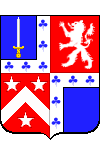
Jean Baptiste Drouët was born on July 29, 1765 in Reims, in Champagne. Son and grandson of carpenters, he himself became an apprentice locksmith before embracing a military career by enlisting at seventeen, in October 1782, in the Beaujolais regiment.
Released in 1787, he joined the Reims Chasseurs Battalion as a volunteer in August 1792 during the French Revolution. Serving in the armies of the North, the Moselle, and Sambre-et-Meuse, he was a private, then a corporal, and was elected captain in April 1794 before becoming aide-de-camp to General François Joseph Lefebvre in May 1794. That year, he participated in the sieges of Valenciennes and Condé, and then fought alongside Lefebvre in Germany until 1799. His career progressed smoothly. He was appointed provisional battalion commander in September 1795, then adjutant general and brigade commander in February 1797. In March 1799, he became chief of staff of Lefebvre's division, and then of Joseph Souham's division in April, this time within the Army of the Danube, commanded by Andréa Masséna.
Drouet was appointed brigadier general on July 25, 1799, shortly after the First Battle of Zurich. He participated in the Second Battle in September, in 's division. After the Army of the Danube was merged with the Army of the Rhine, he served in Germany under Jean Victor Marie Moreau and Antoine Richepance, fighting at Erbach (May 1800), Ulm (June), and Hohenlinden (December 3), where he distinguished himself but was wounded. He nevertheless continued the campaign to its conclusion.
In August 1803, Drouet commanded the vanguard of Joseph Hélie Désiré Perruquet de Montrichard's division in General Mortier's corps. His participation in the conquest of Hanover earned him his third star as a divisional general (August 27). The Legion of Honour soon followed (Knight in December, Commander in June 1804).
During the battle of Austerlitz (December 2, 1805), he was in command of the 2nd division of the 1st army corps led by Marshal Jean-Baptiste Jules Bernadotte.
In 1806, while he participated in the first battle of the Prussian campaign at Schleiz on October 9, his presence at the battle of Jena is mentioned by some sources but omitted by others. Subsequent operations saw him fighting at Halle (October 17) and Lübeck (November 6). At the beginning of 1807, he again served as chief of staff to Lefebvre, who was leading the siege of Danzig [Gdansk]. In May, he captured the island of Holm and then concluded and signed the city's surrender with the governor, Friedrich Adolf von Kalckreuth. On June 14, he was seriously wounded at Friedland.
In 1808 he took command of the 11th military division in Bordeaux and received the title of Count of Erlon (a small locality in the Aisne) in March.
Drouet d'Erlon served as Marshal Lefebvre's chief of staff for the third time in May 1809. He accompanied him to Bavaria and then Tyrol before succeeding him as commander of the 7th Corps in October. There, he successfully concluded the difficult struggle against Andreas Hofer and his supporters.
Returning to France in May 1810, he went back to Bordeaux to command the rearguard division of the Army of Spain. He then took command of its 9th Corps, joining Masséna and the Army of Portugal at Valladolid on September 10. In May 1811, he fought at Fuentes de Oñoro and then assumed command of the 5th Corps in Andalusia under Marshal Jean-de-Dieu Soult, replacing General Victor de Faÿ de La Tour-Maubourg. Still under Soult's command, he led the 5th Infantry Division and the right wing of the Army of the South in February 1812. In October of the same year, still in Spain, he became commander-in-chief of the Army of the Center. He participated in the disastrous battle of Vitoria on June 21, 1813, and then commanded the central corps of the Army of the South.
He led the entire Pyrenees campaign. He fought at the Col de Maya (July 25-28, 1813), on the Nivelle River (November 10), at Saint-Pierre d'Irube (December 9 and 13), at Orthez (February 27, 1814), and at Vic-de-Bigorre (March 19). This series of battles did not hinder the slow but inexorable advance of the enemy forces. On April 10, 1814, several days after Napoleon's first abdication (which he, like the rest of Soult's army, was unaware of), Drouet again distinguished himself by his fighting spirit at the battle of Toulouse.
During the First Restoration, Drouet d'Erlon, having rallied to King Louis XVIII, was appointed commander of the 16th Military Division (covering the departments of Nord and Pas-de-Calais), a Knight of the Order of Saint Louis, and a Grand Cross of the Legion of Honor. However, the new regime had little to be proud of for his services. The court-martial he presided over in January 1815 acquitted General Rémy Joseph Isidore Exelmans, accused of corresponding with the enemy (Joachim Murat, in this instance) and of espionage. Shortly afterward, Drouet participated, perhaps against his will, in the plot hatched by Generals François Antoine Lallemand and Charles Lefebvre-Desnouettes to march troops stationed in northern France on Paris. After the failure of this attempt, he was arrested, but regained his freedom on March 21 and this time managed to seize the citadel of Lille.
Napoleon entrusted him with the 1st observation corps of the Army of the North on April 6 and appointed him to the Chamber of Peers on June 2.
During the Belgian campaign, the contradictory orders he received from Napoleon and Marshal Michel Ney, his direct superior, prevented him from taking part in the battles of Ligny and Quatre-Bras, where his intervention could have proven decisive. At Waterloo, however, he was tasked with the main attack and carried it out vigorously, but with little success, although he eventually managed to capture the Haye-Sainte farm .
In the days that followed, Drouet withdrew his corps behind the Loire River in accordance with the Convention of Saint-Cloud signed by Marshal Louis-Nicolas Davout. However, the spirit of this convention was violated by the royal decree of July 24, 1815, which outlawed a number of prominent figures who had played significant roles during the Hundred Days. Drouet was among the first on the list. With the help of friends, he managed to leave France and sought refuge in Germany, first in Munich, then in Bayreuth, where he established himself as a brewer. There, in 1816, he learned of his death sentence in absentia, pronounced on August 10.
Charles X, on the occasion of his coronation, pardoned Drouet on May 28, 1825. Drouet returned to France where he lived discreetly until the July Revolution. This revolution brought him back into the public eye. Made a Peer of France in November 1831, he was sent to Nantes in 1832 to quell the unrest caused by the landing of the Duchess of Berry, then appointed Governor-General of the French possessions in North Africa on July 27, 1834. His actions not having yielded any clear successes, he was recalled on August 8 to once again command the military division of Nantes. On April 9, 1843, King Louis-Philippe elevated him to the rank of Marshal of France.Drouet died at his home in Paris, 8 rue Thiroux, on January 25, 1844.
He was buried in Reims, in the North Cemetery .
"Jean Baptiste Drouët, comte d’Erlon". Engraving of 19th century.

The name of Marshal Drouet d'Erlon is inscribed on the East pillar of the Arc de Triomphe.
Authors


Didier Grau
Lionel A. Bouchon
This page was written by Didier Grau, Doctor of Medicine, 13008 Marseille, France and Lionel A. Bouchon, Pharmacist, IT specialist. 74540 Gruffy. France. The two of them founded the Napoléon et Empire website in 2008 and have run it together ever since. Their research focuses in particular on the precise location of Napoleonic sites of memory.
About this page
Published on: November 11th, 2025
Reading time: Between 5 and 8 minutes.
Last modified on: November 20th, 2025
Word count: 1184
Number of images: 1