Battle of Ulm
Among Napoleon's successes, the capture of Ulm ranks among the greatest and least costly in human lives. It concluded a series of brilliant maneuvers culminating in the capitulation of an Austrian army of nearly 40,000 men.
Date and place
- October 15th to 20th at Ulm, Baden-Württemberg, on the border with Bavaria.
Involved forces
- French Army (80 000 men), under emperor Napoleon I.
- Austrian Army (40 000 men), under Prince Johann I Joseph of Liechtenstein and general Karl Mack von Leiberich.
Casualties and losses
- French Army : 500 men dead, 1 000 wounded
- Austrian Army : 4 000 dead, 27 000 prisoners
Aerial Panorama
Weather
The weather was dreadful. Rain fell incessantly, causing the Danube to flood. Camps and hospitals were inundated.
Preliminary Operations
At the start of the campaign (the Rhine was crossed on September 25, 1805), Napoleon deployed the various corps of his army in such a way as to isolate General Karl Mack von Leiberich 's corps from the rest of the Austrian forces.
Battle of Haslach
The maneuver nearly failed on October 11 when Mack attempted to escape towards Bohemia while all preparations were in place to intercept him south of the Danube.
Fortunately for the French, near Haslach (north-northeast of Ulm), his retreat was thwarted by the division of Pierre Dupont de l'Étang (VI Corps), which was advancing, followed at a distance by the foot dragoons of Louis Baraguey d'Hilliers , to take possession of a town that the French command believed had been abandoned by its defenders.
Despite being overwhelmingly outnumbered, and lacking the support of Baraguey d'Hilliers, who had been warned too late, Dupont managed to halt the Austrian advance at the cost of destroying two of his regiments. The audacity of the French general — he had taken the initiative in the attack — convinced Mack that he was facing the vanguard of the Grande Armée. He turned back and retreated to Ulm.
French Preparations
On the 12th, Napoleon drew conclusions from this engagement. He urgently needed to send additional troops north of the Danube, as the remnants of Dupont's division alone could not contain Mack if he attempted another escape. Since the Russian reinforcements arriving from the northeast to come to Mack's aid were still far away, he had the necessary time. Marshal Michel Ney, at the head of the VI Corps, was therefore tasked with capturing the Elchingen bridge in order to reopen a passage to the north of the Danube. This was accomplished two days later.
On the evening of the battle of Elchingen, during the night of October 14-15, 1805, Napoleon sent the three divisions of Jean Lannes's V Corps and the dragoons of Dominique-Louis-Antoine Klein to join Ney on the left bank of the Danube.
Austrian Dissension
On the same day, General Werneck's corps left Ulm to search for a way for the Austrian army to escape encirclement. He clashed with Dupont, who defeated him and blocked his path back.
In the city, a heated argument erupted between Archduke Ferdinand Charles Joseph of Austria-Este, the nominal head of the army and advocate for a swift evacuation, and General Mack, his chief of staff, who intended to hold on. Mack suddenly produced a government document granting him precedence in case of disagreement with his superior. The Archduke, furious, disregarded his former subordinate's orders and left the city with 6,000 cavalry and a small contingent of infantry.
French Positions
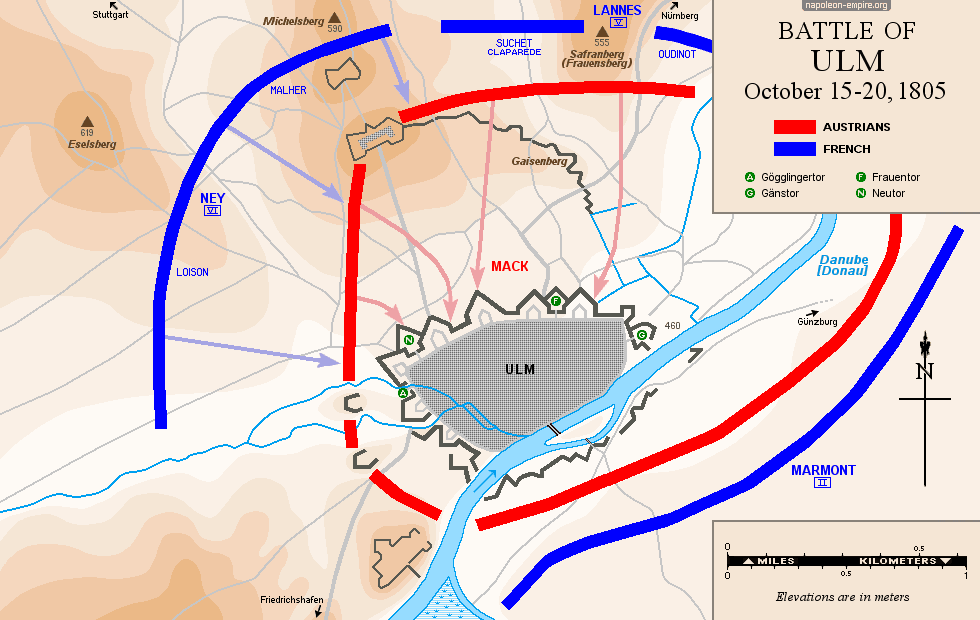
On the morning of the 15th, the city was surrounded. The positions of the various French corps were organized as follows:
- Ney (VI Corps) formed the right (western) wing of the formation, extending from the Mähringen woods on the right to the area in front of Jungingen, with the center facing Lehr;
- Lannes (V Corps) was positioned to his left, with, from right to left, Louis-Gabriel Suchet's division, with Michel Marie Claparède 's brigade, and then Nicolas Oudinot's grenadier division, which cut the road to Albeck;
- Served as reserves:
- The Guard occupied Haslach, anchoring its left flank on Thalfingen;
- The 4th Dragoon Division of François Antoine Louis Bourcier ;
- The 1st Heavy Cavalry Division of Étienne Marie Antoine Champion de Nansoutyi .
- Auguste Frédéric Louis Viesse de Marmont (II Corps) completed the deployment south of the Danube, with Marc Antoine Bonin de la Boninière de Beaumont 's 3rd Dragoon Division and Baraguey d'Hilliers' Foot Grenadier Division (Cavalry Reserve).
The latter two belonged to the cavalry reserve commanded by Joachim Murat and were positioned behind Lannes;
The Battles Around Ulm
On October 15, 1805, Napoleon invited the Austrians to surrender. Mack refused. He was counting on the imminent arrival of a Russian army. He perhaps also hoped for a French withdrawal, based on false information provided by Napoleon's spy, Karl Ludwig Schulmeister. Meanwhile, his only weakness was his lack of supplies. Otherwise, he had ample ammunition and knew that the French currently possessed no siege equipment.
Faced with this refusal, Ney launched an offensive around 2:30 p.m., sending General Jean-Pierre Firmin Malher (VI Corps) to seize the heights of the Michelsberg [48.41168, 9.98326], which overlooked the city of Ulm to the north-northwest.

After being repelled the first time, they returned to the attack and took possession of this strategic position.
Simultaneously, the General Louis-Gabriel Suchet (V Corps) attacked the nearby Frauensberg [48.41173, 9.98812] to the north.
That evening, the French troops of General Louis Henri Loison (VI Corps) advanced so close to the city walls that Ney attempted to take it immediately. The divisions of Generals Suchet and Claparède launched a counter-attack. They captured a bastion. Some soldiers even managed to penetrate the city walls, where they were taken prisoner. The rest were repelled.
Following these battles, the city of Ulm was tightly encircled by the corps of Ney and Lannes to the north, and that of General Marmont to the south.

Meanwhile, Austrian Field Marshal Franz von Werneck attempted to advance on the French rear between Langenau and Albeck in order to attack them on the 16th. Archduke Ferdinand, who had joined him at Heidenheim with the 11 squadrons remaining after the fierce pursuit led by Murat, forbade him from doing so.
The Surrender of Ulm
On the 16th, Napoleon refused the assault his marshals demanded. He saw it as too costly in men and ammunition to hasten a fall that seemed inevitable to him.
On the Austrian side, the generals then asked their leader to lay down his arms. Mack, still hoping for the imminent arrival of the Russians, initially rejected their request.
However, the next day, faced with a lack of food and after enduring a brief bombardment, he relented and entered into negotiations with Napoleon. He signed an agreement with Louis-Alexandre Berthier, the terms of which seemed sufficiently honorable to him, stipulating that the fortress would be surrendered to the French army on the 25th if no reinforcements arrived before then.
On the 18th, harassed by Murat, Werneck laid down his arms at Trochtelfingen, along with the 8,000 men surrounding him. Archduke Ferdinand managed to escape to Bohemia with barely 2,000 cavalrymen.
On October 19th, informed by Napoleon of this capitulation, Mack resigned himself to anticipating his own surrender.
The following day, 27,000 men and 18 Austrian generals paraded for five hours before Napoleon and his staff. Unlike the soldiers, who were held captive, the officers were allowed to keep their weapons and return home if they pledged not to fight against France again.
The outcome
The French lost only about 1,500 men.
4,000 Austrian soldiers were killed and 27,000 taken prisoner, belonging to the following infantry regiments, some of which were among the most distinguished Austrian units:
- #1 (Emperor Francis II)
- #3 (Archduke Charles)
- #8 (Archduke Louis)
- #11 (Archduke Rainer)
- #12 (Friedrich Marchese Manfredini)
- #15 (Freiherr Carl von Riese)
- #24 (Carl von Auersperg)
- #28 (Michael von Fröhlich)
- #36 (Johann Karl Kolowrat-Krakowsky)
- #41 (Friedrich von Sachsen-Hildburghausen)
- #54 (Joseph Froon von Kirchrath)
- #57 (Joseph Maria von Colloredo-Mels und Wallsee)
- #64 (Johann Gabriel Chasteler de Courcelles)
65 cannons and 40 flags also fell into French hands.
The victory was total. It was a true strategic triumph for Napoleon.
General Mack was sentenced by an Austrian court-martial to degradation and two years' imprisonment. In 1819, he was reinstated in the army at Schwarzenberg's request.
Map of the battle of Ulm
Picture - The surrender of Ulm. Painted by Charles Thévenin (1764 - 1838).

Karl Ludwig Schulmeister's role in the capitulation of Ulm has been embellished by legend. It is certain that he was in contact with General Mack. The latter confirmed this during his appearance before the court-martial that examined his conduct. However, until around October 15th, it is almost certain that Napoleon's future master spy
was indeed working for the Austrians. The information he provided them before that date was accurate. That they did not take advantage of it is their own fault. Afterward, however, Schulmeister changed sides. The note he wrote for Anne Jean Marie René Savary on October 21st was presented as an initial report, detailing the information delivered to Murat on the 17th and the instructions received from Savary on the 18th. Furthermore, it is known that Napoleon did not have reliable intelligence until this period. Schulmeister had therefore not yet entered his service.
Orders of battle of October 15, 1805
French order of battle
| Emperor Napoleon Ist | Imperial Guard | Marshal Jean-Baptiste Bessières | II Army Corps | General Marmont | 1st division of infantry | General Jean Boudet |
| 2nd division of infantry | General Emmanuel de Grouchy | |||
| 3rd Batavian infantry division | General Jean-Baptiste Dumonceau | |||
| Cavalry | General Jean Laurent Justin Lacoste-Duvivier | V Army Corps | Marshal Lannes | 1re division de grenadiers | General Oudinot |
| 2nd division of infantry | General Honoré Théodore Maxime Gazan | |||
| 3rd division of infantry | General Suchet | |||
| Cavalry | Brigadier General Jean-Louis François Fauconnet | VI Army Corps | Marshal Ney | 1st division of infantry | General Dupont de l'Étang |
| 2nd division of infantry | General Loison | |||
| 3rd division of infantry | General Malher | |||
| Cavalry | General Jacques Louis François Delaistre de Tilly | Cavalry reserve | Marshal Murat | 1st division of heavy cavalry | General Nansouty |
| 2nd division of heavy cavalry | General Jean Joseph Ange d'Hautpoul | |||
| 1st division of dragoons | General Klein | |||
| 2nd division of dragoons | General Frédéric Henri Walther | |||
| 3rd division of dragoons | General Bonin de la Boninière de Beaumont | |||
| 4th division dofdragoons | General François Antoine Louis Bourcier | |||
| Foot Dragoon Division | General Baraguey d'Hilliers | |||
Austrian order of battle
| Archduke Ferdinand (Nominal Commander-in-Chief) Feldmarschalleutnant Mack (Effective Commander-in-Chief) | ||||
| Kienmayer Army Corps | Feldmarschalleutnant Michael von Kienmayer | Caramelli Brigade | General Major Johann Karl Caramelli | |
| Thelen Brigade | General Major Konrad von Thelen | |||
| Hager Brigade | Colonel Johann Nepomuk Hager von Altensteig | |||
| Nostitz Brigade | General Johann Nepomuk Nostitz-Rieneck | Werneck Army Corps | Feldmarschalleutnant Werneck | Auffenberg Division | Feldmarschalleutnant Franz Xaver von Auffenberg |
| Kerpen Division | Feldmarschalleutnant Wilhelm Lothar Maria von Kerpen | |||
| Hohenzollern Division | Feldmarschalleutnant Friedrich Franz Xaver zu Hohenzollern-Hechingen | |||
| Aspre Detachment | General Major Konstantin Ghilain Karl d'Aspré von Hoobreuk | Schwarzenberg Army Corps | Feldmarschalleutnant Karl Philipp zu Schwarzenberg | Klenau Division | Feldmarschalleutnant Johann Joseph Cajetan Klenau und Janowitz |
| Gottesheim Division | Feldmarschalleutnant Friedrich Heinrich von Gottesheim | Riesch Army Corps | Feldmarschalleutnant Johann Sig(is)mund von Riesch | Gyulay Division | Feldmarschalleutnant Ignaz Gyulai von Máros-Németh und Nádaska |
| Loudon Division | Feldmarschalleutnant Johann Ludwig Alexius von Loudon | |||
| Hessen-Homburg Division | Feldmarschalleutnant Friedrich VI Joseph Ludwig zu Hessen-Homburg | |||
Photos Credits
Photos by Lionel A. Bouchon.Photos by Marie-Albe Grau.
Photos by Floriane Grau.
Photos by Michèle Grau-Ghelardi.
Photos by Didier Grau.
Photos made by people outside the Napoleon & Empire association.