Mikhail Bogdanovich Barclay de Tolly
Prince
Pronunciation:
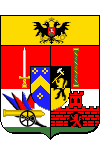
Mikhail Bogdanovich Barclay de Tolly [Михаи́л Богда́нович Баркла́й-де-То́лли] was born into a Baltic German family of Scottish origin who had settled in Riga [now in Latvia] in the 17th century. The exact date and place of his birth remain debated. The most frequently cited date is December 27, 1761, but it appears that this was actually the date of his baptism. The city of Chernyakhovsk (formerly Insterburg) officially celebrated Barclay's 250th birthday on December 25, 2007. However, other authors have proposed, with some justification, that the future prince was born in 1755 or 1758. Regarding the location, Barclay de Tolly himself stated that he was born in Riga, but most of his biographers mention Pomautsch [Pamūšis] in Livonia, more precisely in the Duchy of Courland [now in Lithuania] . However, some place the event instead on the estate of Lude Großhoff, near Walk [now Valka in Latvia].
Wilhelm Barclay de Tolly, Mikhail's grandfather, was mayor of Riga, a city that only became part of Russia in 1710. His father, Weingold Gottard (Russified as Bogdan) Barclay de Tolly (1734–1781), served in the army before retiring as a lieutenant. This rank allowed him to be the first member of his family to join the ranks of the Russian nobility. His mother, Margaretha Elisabeth von Smitten (1733–1771), was the daughter of a pastor (other sources place her birth into a line of landowners). Both her parents were German speakers.
After spending his early childhood in Bekhof, Livonia [now Jõgeveste in Estonia], young Mikhail was sent to Saint Petersburg [Санкт-Петербу́рг] in 1765. There he was raised by his uncle by marriage (the husband of his mother's sister), Georg Wilhelm von Vermelin, a colonel of cuirassiers. The latter considered him his adopted son and gave him an excellent education, which included fluency in three languages: German, Russian, and French.
Mikhail joined the army in 1776, in the Pskov [Псков] Carabiniers Regiment. His relatively modest origins slowed his advancement. He became a cornet in 1778, then a second lieutenant in 1783.
In January 1786, he joined the Finnish Jaeger (hunters) corps as a lieutenant and became a captain two years later (January 1788).
Barclay de Tolly participated in the beginning of the Russo-Turkish War of 1787-1791 and then switched in 1789 to the Russo-Swedish War of 1788-1790. His conduct during these two conflicts, in particular during the capture of Ochakov (1788), the battle of Kauchany (September 1789) and the assault on Akkerman [Bilhorod-Dnistrovskyi] (November 1789), earned him several decorations in addition to his promotion.
On September 2, 1791, Barclay married his cousin, Helen Augusta Eleanor von Smitten. Later that year, he was promoted to battalion commander in the St. Petersburg Grenadier Regiment. In 1794, he participated in the suppression of Tadeusz Kosciuszko's Polish uprising, concluding the campaign as a lieutenant colonel in the Eastland Jaeger Corps. On March 18, 1798, he became colonel of the 4th Jaeger Regiment, whose outstanding service soon led to his promotion to major general (March 13, 1799).
During the 1805 campaign, Barclay commanded a brigade in the army of Levin August Gottlieb Theophil (Leonty Leontyevich) von Bennigsen. The Allies having neglected to wait for Bennigsen before engaging in the battle of Austerlitz, Barclay did not participate.
A year later, in Poland, still under Bennigsen, Barclay successively commanded the vanguard and then the rearguard. In these positions, he distinguished himself at the battles of Pułtusk and Preußisch Eylau. Severely wounded in the right arm, he was treated in Königsberg [present-day Kaliningrad] and then in Memel [present-day Klaipėda, Lithuania], and used this enforced leisure to devise a plan of action in the event of an invasion of Russia by Napoleon I. He laid the foundations for the strategy that would be followed in 1812 and had the opportunity to present his views to Tsar Alexander I, whom he met twice in the city of Memel in April 1807. At the end of the hostilities, Barclay was promoted to lieutenant general and given command of the 6th Infantry Division.
In 1808, during the Russo-Swedish War of 1808-1809, this unit was transformed into an expeditionary force and deployed to Finland. Barclay captured the town of Kuopio there and held it despite several enemy assaults. However, due to illness, he had to temporarily leave the theater of operations from August 1808 to February 1809.
On that date, he took command of Vaasa's corps. He surprised the enemy by successfully crossing the Kvarken Strait (Gulf of Bothnia) on the ice, allowing him to occupy the city of Umeå, on the Swedish coast, without a fight. After fruitless negotiations between the belligerents following this daring feat, the fighting resumed. Nevertheless, on April 1, 1809, Barclay was appointed general of infantry, and then on the 10th, commander-in-chief of the Finnish army. He finally became governor-general of Finland after Sweden ceded this province and the Åland Islands to the Russian Empire by the Treaty of Fredrikshamn (present-day Hamina, Finland) of September 17, 1809.
His promotion to the rank of infantry general, despite being only 47th in seniority among lieutenant generals, triggered several resignations. Those overlooked protested against what they considered preferential treatment.
From February 1, 1810, to September 5, 1812, Barclay held the War portfolio in the Russian government. He used this position to reform the army's structure, introducing corps-based organization and a unified command structure under a single commander answerable only to the Tsar. His ministry also took measures to increase troop numbers in anticipation of war, calling up as many as two percent of the male population to military service. Substantial food stocks were built up to supply these troops, and the production of weapons and ammunition was significantly increased. In total, the share of the state budget spent on military purposes during the years 1810-1812 approached fifty percent.
Barclay's ministry also devised two plans of action in the event of war with France: one offensive, the other defensive. The first envisioned encircling enemy troops in Prussia and then rapidly advancing on the French borders through Germany. The second advocated avoiding major engagements against Napoleon's forces in order to prolong the operations and draw the enemy into the heart of a deliberately devastated country, where they would be worn down without recourse.
On April 12, 1812, in addition to his ministry, Barclay received command of the 1st Western Army, based on the western border of the Russian Empire, in Lithuania.
When the Russian campaign began in June 1812, the defensive strategy, known as "scorched earth," was the only option available. The superior power of the Napoleonic Empire precluded any other possibility. Barclay did, however, fight a few rearguard battles, at Vitebsk and then at Smolensk.
This course of action was repugnant to the local population, the nobility, and especially the "Russian party" at court. The latter saw Barclay as nothing more than a "German" and worked tirelessly for his dismissal. They portrayed Barclay at best as a coward, at worst as a traitor. Prince Pyotr Ivanovich Bagration himself, commander of the 2nd Army, soon made no secret of his disagreements with the minister. Moreover, a dispute existed between the two men regarding the legitimacy of Barclay's precedence. Barclay acted as Bagration's superior, even though the Tsar had never formally granted him supreme command, and his rival considered himself the more senior of the two in their respective ranks.
On August 17, 1812, his subordinates, supported by Alexander I, pressured Barclay to contest the city of Smolensk with Napoleon. However, the general again refused battle, seeing his line of retreat threatened, and withdrew once more, abandoning the city after destroying everything that could be of use to the French. But Smolensk was not just any town. It derived its sacred character from the presence, in the Dormition Cathedral, of one of the most revered images of the Russian Orthodox Church: the icon of the Mother of God of Smolensk, reputed to have been painted by Saint Luke himself. The fall of the city fueled such discontent among both civilians and the army that the Tsar was forced to dismiss Barclay and appoint General Mikhail Illarionovich Golenishchev-Kutuzov as commander-in-chief. The change took effect on August 29.
A few days later, on September 7, at Borodino, Kutuzov, having been chosen for this purpose, finally offered Napoleon the battle the latter had been seeking since the beginning of the campaign. Barclay, who had also lost his ministerial post on September 5, now commanded only the 1st Army, positioned on the right and center of the Russian line. He fought valiantly and skillfully, without regard for his safety. Some even suspected him of having deliberately risked his life in response to accusations from society and the censure of his soldiers, who had refused to salute him before the battle.
Nevertheless, he continued to defend the continuation of the retreat and the abandonment of Moscow during the war council held in Fili on September 13. His letters to his wife attest that he was completely convinced of the soundness of the strategy he had implemented throughout his command.
After the abandonment of Moscow, Barclay's position became even more precarious. He and Kutuzov were not communicating. The two men differed too much, both in character and behavior, to reach an agreement. Moreover, the reorganization undertaken by the new commander-in-chief effectively deprived Barclay of his autonomy. His health deteriorating, he obtained leave and left the army on October 2nd.
Barclay used his free time to write a report justifying the decisions he had made during his command. In November, he sent it to the Tsar. In his reply, the Tsar fully endorsed all of the general's actions.
Wishing to publicize this imperial approval, Barclay traveled to Saint Petersburg to obtain a private audience with the sovereign. Such a favor would have the effect of rehabilitating the former minister in the eyes of the public. Unfortunately, the Tsar had already returned to the army when Barclay arrived. However, the behavior of Tsarina Elizabeth Alexeievna, who received him with the utmost affability, compelled the courtiers to soften their initially frosty demeanor.
Recalled to the front by a letter from Alexander I, Barclay finished his recovery at his estate in Livonia and then left for Wilna [Vilnius] at the beginning of 1813.
On February 4, 1813, Barclay took command of the 3rd Army. On May 29, he replaced Pyotr Khristyanovitch Wittgenstein as commander of the Russo-Prussian forces. When the Armistice of Pleiswitz [Pielaszkowice], which had halted hostilities from June 4 to August 10, 1813, came to an end, these troops were integrated into the Army of Bohemia under the Austrian Field Marshal Charles Philipp von Schwarzenberg.
In these successive posts, Barclay carried out the campaigns in Saxony and then France (1814), participating in the battles of Bautzen, Dresden, Kulm, Leipzig, La Rothière, Arcis-sur-Aube, Fère-Champenoise and Paris.
On January 10, 1814, Barclay was granted the title of hereditary count of the Russian Empire. On March 30 of the same year, he became a field marshal.
After the end of hostilities, he accompanied his sovereign on his triumphant journey to London and then received command of the 1st Army, stationed in Poland.
After Napoleon's return, Barclay and his soldiers once again set out for France, but they only arrived after the battle of Waterloo. had caused another abdication of the Emperor of the French, thus ending the Hundred Days.
Barclay and his troops established themselves in Champagne. On September 11, 1815, Barclay was raised to the rank of prince. In October, he left France with the Tsar and returned to Poland. In December, Alexander I received him solemnly in Saint Petersburg. Throughout this period, Barclay was showered with decorations from all corners of monarchical Europe. The King of France himself awarded him the Legion of Honor.
During the following years, Barclay continued to command the 1st Army from his headquarters in Mogilev while publishing various works on military theory. In 1817, he accompanied the Tsar on an inspection tour.
At the beginning of 1818, Barclay requested leave to take the waters in Germany. He died on May 26 on the road to Carlsbad, at Shtilitzen Castle [Zhilyaitshen], about six kilometers from the city of Insterburg [Chernyakhovsk, Kaliningrad Oblast], in East Prussia. The death certificate attributed his death to gallstones.
The body was repatriated to Riga, where a solemn funeral service was held on June 11 in St. James' Cathedral. On July 25, he was buried in the family tomb on his Beckhof estate [now Jõgeveste, Estonia].
"Mikhail Bogdanovich Barclay de Tolly", by George Dawe (St James's, Westminster 1781 - Kentish Town 1829).

Barclay's grave was desecrated during World War II, with the German and Soviet belligerents also vying for control of his memory.
Numerous monuments commemorate Marshal Barclay de Tolly. However, his influence on the course of the Russian campaign was for a long time largely downplayed in favor of Kutuzov's. All Russian historians now acknowledge that Kutuzov persisted in the strategy chosen by his predecessor in the initial stages of the war. But proponents of Russification in the 19th century resented owing the salvation of the sacred Russian land to someone they considered a foreigner. Leo Tolstoy, in particular, through his novel War and Peace, succeeded in imposing a biased view of events for decades.
All dates on this page are in the Gregorian calendar (then eleven and then twelve days ahead of the Julian calendar in use in Russia at the time).
Authors

Didier Grau
Lionel A. Bouchon
This page was written by Didier Grau, Doctor of Medicine, 13008 Marseille, France and Lionel A. Bouchon, Pharmacist, IT specialist. 74540 Gruffy. France. The two of them founded the Napoléon et Empire website in 2008 and have run it together ever since. Their research focuses in particular on the precise location of Napoleonic sites of memory.
About this page
Published on: April 4th, 2024
Reading time: Between 9 and 14 minutes.
Last modified on: November 17th, 2025
Word count: 2145
Number of images: 1