Karl Ludwig Schulmeister
Pronunciation:
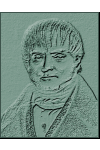
Karl Ludwig Schulmeister was born on August 5, 1770, in Neue-Freistett, in the Duchy of Baden, to a Lutheran pastor.
After working as a civil servant, he set up shop as a hardware merchant in his hometown, a trade he pursued until 1797.
It was perhaps around this time that he met Anne Jean-Marie René Savary, a captain in the French troops who operated in the Neue-Freistett region on two occasions, in June 1796 and then in April 1797.
In 1798, he settled in Strasbourg as a grocer and tobacconist, while also engaging in smuggling.
According to many authors, Schulmeister obtained his job as a spy in September 1805 by appearing before Napoleon I himself in various inscrutable disguises. The Emperor was then on his way to take command of the Grande Armée and begin the campaign in Germany.
However, no official document or credible testimony supports what is most likely a fabrication. This is especially true given that Schulmeister was at the time in trouble with the French authorities. The prefect of the Bas-Rhin department, Henri d'Alton de Shée, had just issued an expulsion order against him.
In fact, in September 1805, he was working for the Austrians. General Karl Mack von Leiberich confirmed this before the court-martial held in 1806-1807 to examine his conduct during the previous campaign.
The information Schulmeister provided him up until mid-October was accurate, and he was not held responsible for its misuse by his employers.
He switched sides around October 15, during a mission to Stuttgart. On the 21st, he submitted his first report to Savary. After the surrender of Ulm, Savary sent him east to the area of operations of Mikhail Illarionovich Golenichev-Kutuzov (Михаил Илларионович Голенищев-Кутузов)'s Russian forces.
On his way, he encountered an Austrian officer who was a friend of his. Not only did he gain direct access to information, but his interactions with the Allied military in Braunau also allowed him to mingle. He thus learned of the Russians' intention to withdraw and await reinforcements. He immediately alerted the French.
Despite, once again, the absence of any official document confirming it, legend tells of Schulmeister's arrest by the Austrians, followed by his escape.
What is certain, however, is that he reported to Savary in Vienna [Wien] on November 13th. Two days later, Schulmeister was appointed Commissioner of the Security Police in the military government of General Antoine François Andréossy. He was highly active in this role, supported by a network of emissaries sent into enemy territory.
His situation during the months following the Peace of Pressburg remains unclear: another arrest by the Austrians during a different mission, a return to Strasbourg... once again, no document provides a definitive answer.
On March 19, 1806, however, his presence in Paris is confirmed by a letter Savary gave him to the Prefect of the Bas-Rhin. In it, he requested the withdrawal of the expulsion order issued the previous year, in recognition of the services he had rendered to the French army.
Freed from this Damoclean sword, Schulmeister acquired the vast estate of La Canardière in Meinau, near Strasbourg. The war had made him considerably wealthy.
Schulmeister participated in the Prussian and Polish campaigns alongside Savary. On September 17, 1806, Savary wrote to him ordering him to return to active duty. Schulmeister began by gathering intelligence in Dresden. He then accompanied his mentor, who commanded a brigade of light cavalry, and later, from January to March 1807, the Fifth Corps, replacing the ailing Jean Lannes. In this capacity, Schulmeister captured the town of Wismar, participated in the Battle of Ostrolenka, and then in the Battle of Friedland (Pravdinsk), where he was wounded. He would bear a facial scar from this engagement.
On June 17, 1807, Schulmeister was appointed Prefect of Police of the city of Königsberg, of which Savary was governor. He held this position until the Peace of Tilsit.
The following year, still under Savary's patronage, Schulmeister became head of security for the city of Erfurt during the meeting between Napoleon, Tsar Alexander I, and all of Germany's crowned heads. His position made him responsible for the sovereigns' security.
Schulmeister ended 1808 in Strasbourg. There, among other activities, he worked to acquire, on behalf of Savary, recently appointed Duke of Rovigo, the German estates attached to that title.
During the Austrian campaign, Schulmeister, recalled by Savary, devoted himself to matters of military policing. While he did engage in espionage, no official record of it was kept. Moreover, Napoleon, until battle of Aspern-Essling, was poorly informed.
On May 13, 1809, Savary was sent to Vienna as part of the ongoing negotiations for the city's surrender. A hostile group attacked him. Schulmeister, present as an interpreter, saved his leader's life by shooting one of the assailants. Shortly afterward, he resumed his 1805 position as Commissioner General of Police (or Central Commissioner). He returned to Strasbourg after the Treaty of Schönbrunn.
In the following years, with Savary now serving as Minister of Police, Schulmeister no longer participated in the Napoleonic campaigns. While he did contribute to the government, no record of this has survived.
During the Hundred Days, contrary to legend, he did not enter Austria to abduct the King of Rome. Perhaps, however, he did deliver Napoleon's last letter to empress Marie-Louise.
When the Allies entered Paris on July 6, 1815, Schulmeister, knowing he was wanted, went into hiding. He was first found by the Austrians, who offered him a job. He accepted and provided them with political information. But the Prussians, in turn, tracked him down and, less conciliatory, arrested him.
The signing of the Second Treaty of Paris secured his release. He returned to Strasbourg, but he had lost a good part of his fortune and had to sell some of his properties.
He died at home on May 8, 1853, and was buried in the Saint-Urbain cemetery in Strasbourg, section 5.
"Portrait of Schulmeister", by Charles Auguste Schuler

The official positions Schulmeister held during the Napoleonic campaigns seem hardly compatible with the role of a spy and the adventures attributed to him. His reputation, however, spread very quickly. Charles-Louis Cadet de Gassicourt recounted his exploits in his memoirs and claimed to have verified their veracity with a considerable number of senior officers. The lack of documents and consistent testimonies certainly warrants doubt.
If one nevertheless decides to believe his legend, Schulmeister's main claim to fame would be the capitulation of Ulm. The spy supposedly entered the city in disguise, met with Mack several times while posing as a Hungarian, and convinced him of Napoleon's imminent departure by means of a fake newspaper announcing a revolution in France. Mack's unfortunate decision to shut himself up in Ulm would therefore be essentially his doing.
The legend also credits him with the audacity of having invited himself, that same year 1805, to a council of war presided over by the Emperor of Austria himself.
Authors

Didier Grau
Lionel A. Bouchon
This page was written by Didier Grau, Doctor of Medicine, 13008 Marseille, France and Lionel A. Bouchon, Pharmacist, IT specialist. 74540 Gruffy. France. The two of them founded the Napoléon et Empire website in 2008 and have run it together ever since. Their research focuses in particular on the precise location of Napoleonic sites of memory.
About this page
Published on: March 2nd, 2026
Reading time: Between 5 and 8 minutes.
Last modified on: March 15th, 2026
Word count: 1186
Number of images: 1