Roustam Raza
Mamluk of the Emperor
Pronunciation:
Roustam Raza was born in Tiflis (now Tbilisi), Georgia, around 1780 or 1782, the sixth child of an Armenian merchant, Roustam Honan, and a Georgian woman, Bouchid-Vari. He was two years old when his family returned to Aperkan in Armenia, where his father was originally from. On the eve of adolescence, when his family was dispersed during the Persian-Armenian war, young Roustam was kidnapped by Tarars and sold into slavery seven times.
In 1797, he was bought in Constantinople by a Cairo bey, who integrated him into his Mamluk cavalry corps. He did not take part in the battle of the Pyramids, making a pilgrimage to Mecca with his master. On the latter's death, he entered the service of Sheik El Bekri in Cairo, who, a friend of general Napoleon Bonaparte, handed him over to him in August 1799.
Roustam returned to France with Napoleon and soon became the bodyguard and intimate of the First Consul, then of the Emperor, sleeping at his bedroom door and following him on every campaign. From Spain to Prussia, from Italy to Austria and Russia, he never went unnoticed at his master's side, in his oriental costume reminiscent of the conquest of Egypt, which quickly became a source of inspiration for milliners.
In 1811, illness having interrupted his service, he was joined by a second, Louis Étienne Saint-Denis, who wore the same costume and received the nickname of Mameluke Ali
On the evening of April 12, 1814, in Fontainebleau, Napoleon 1st, who had just abdicated, tried to commit suicide with poison. The next morning, he asked Roustam to bring him his pistols. Frightened at the thought of being accused of attempted assassination, the loyal mameluck fled. During the Hundred Days, he again offered his services to the Emperor, but the latter, who had not understood his departure the previous year, turned him down.
In 1824 and 1825, he was in London, where he earned a living showing off his exotic garb in the city's theaters.
In 1827, Roustam settled in Dourdan (then in the department of Seine-et-Oise) with his wife Alexandrine (married in 1806 on her return from the Austerlitz campaign), who had obtained the post office revenue there. He devoted himself to raising their children: a son, Achille, who would go on to work for the Journal Officiel, and a daughter who would marry a Paris bailiff. Roustam died there on December 7, 1845, and was buried in the town cemetery.
"Mamluk Roustam Raza" painted in 1806 by Jacques-Nicolas Paillot de Montabert (Troyes 1771 - Saint-Martin-es-Vignes 1849).

Roustam left written Memoirs, found and published in 1911.
During the Moscow fire of 1812, when houses belonging to the Armenian Church escaped the flames, Roustam asked Napoleon to spare them from requisition, which he obtained.
Acknowledgements
This biographical notice was written by Mrs. Marie-Christine Pénin (see her website Tombes et Sépultures), and posted online with her kind permission.Other portraits
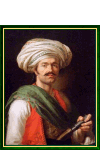

"Roustam Raza" painted in 1811 by Emile Jean Horace Vernet (a.k.a. Horace Vernet, Paris 1789 - Paris 1863).
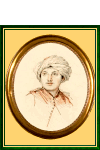
"Roustam Raza". Drawing by Mathieu-Ignace Van Bree (Antwerp 1773 - Antwerp 1839).
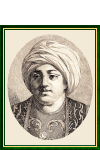
"Rustan, der Leib Mameluck des Kaisers Napoleon". Print of the nineteenth century.