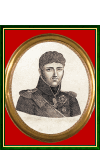
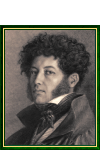
Camillo Borghese
Prince, Duke of Guastalla
Pronunciation:
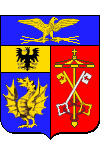
Camillo Filippo Ludovico Borghese was born in the Eternal City on July 19, 1775. He came from a noble, illustrious and wealthy family originally from Siena. His father was the nephew of Pope Paul V.
The young prince was among the first transalpine to become enthusiastic about the principles of the French Revolution. Some claimed that it was mainly about saving the family's patrimony, severely damaged during the entry of the French into Italy, but still considerable (more than two million in annual income).
In 1803, Prince Camillo Borghese traveled to Paris where he met the First Consul. Although he initially showed some reluctance towards the project, his wealth and social standing, combined with some Vatican intrigues, soon led to his marriage to Pauline Bonaparte, widow of General Charles Victor Emmanuel Leclerc.
The wedding took place on November 6, 1803, at the Château de Mortefontaine - property of Joseph Bonaparte, whose role was decisive in this alliance - without the one year and six weeks period recently established by Napoleon Bonaparte before a remarriage following the loss of a spouse being fully respected.
Camillo Borghese, recently created a French prince (1804) and decorated with the Grand Cordon of the Legion of Honour, was made duke of Guastalla in 1806, title vacant since the extinction of the eponymous line in 1746.
Meanwhile, the couple had settled in Rome, where the young bride had quickly displeased her new husband with her extramarital affairs. It must be said that she herself was dissatisfied with her husband, who rapidly became unbearable. Pauline then turned to her all-powerful brother, who sent the troublesome husband to the army.
Camillo therefore accompanied Napoleon I as an officer of the Imperial Guard for the campaigns of Germany in 1805, Prussia in 1806 and Poland in 1807.
After the Peace of Tilsit, he was appointed Governor of Piedmont, and moved to Turin for these new duties.
In 1809, he commanded two divisions of the French Army.
He was naturally dismissed at the end of the Empire, in favour of Austria. He then separated from his wife - with whom he had long since lost all affinity and contact - and settled in Rome, then in Florence .
It was in the Tuscan capital that Prince Camille Borghese gave up his soul to God on April 10, 1832.
"Prince Camillo Borghese" by François Pascal Simon Gérard (Rome 1770 - Paris 1837).

Other portraits
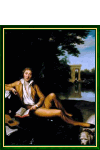

"Camillo Borghese", painted in 1799 by Bernardino Nocchi (Lucca 1741 - Rome 1812).