Charles Victor Emmanuel Leclerc
Pronunciation:
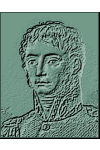
Charles Victor Emmanuel Leclerc was born on March 17, 1772 in Pontoise, near Paris, to a flour merchant.
In 1791 or 1792, he enlisted in the Seine-et-Oise volunteer battalion. Noticed by his superiors, he was transferred the following year to the cavalry with the rank of second lieutenant and then, very quickly, moved to the Army of Italy as assistant to the adjutants-general. In 1793, at barely twenty-one years old, he was chief of staff of one of the divisions tasked with besieging Toulon.
It was there that he met Napoleon Bonaparte and fell under the spell of Pauline Bonaparte. She herself, at the time very much in love with Stanislas Fréron, a representative on mission, paid little attention to this obscure officer.
In 1796 and 1797, Leclerc served in the Army of Italy, where he was initially responsible for the political correspondence of the commander-in-chief. Having subsequently distinguished himself by his bravery at Lonato, Roveredo, and Rivoli, he was tasked with delivering the preliminaries of the Peace of Leoben to Paris (along with some enemy flags, of which Bonaparte always had an ample supply).
Upon his return, he was promoted to general and won the hand of a Pauline who seemed determined that her new status as a married woman would not change her frivolous and dissipated life, contrary to the hopes of her brother.
Chief of staff to Louis-Alexandre Berthier in the Army of Italy after the signing of the Treaty of Campo Formio, then in charge of the same functions in the Army of England (the one intended in principle to invade the British Isles), he did not participate in the Egyptian expedition (contrary to what is sometimes read, the confusion probably coming from the presence in the expedition of General Pierre Leclerc d'Ostein).
Major General in August 1799, Charles Victor Emmanuel Leclerc was in Lyon in October, busy reorganizing the army of Italy defeated by the Austro-Russians, when he decided to accompany Joseph and Lucien Bonaparte, on their way to join their brother who had recently landed in Saint-Raphaël.
During the coup d'état of 18 and 19 Brumaire year VIII, his contribution to the success of the operation was not insignificant. With his brother-in-law Joachim Murat, he led, on the 19th, the detachment of grenadiers which was tasked, in Saint-Cloud, with emptying the meeting hall of the Legislative Body.
His reward, however, was not particularly impressive: his other brother-in-law, Napoleon Bonaparte, now First Consul, initially sent him to the Army of the West before giving him command of a reserve division in the Army of the Rhine, where his main mission was to keep an eye on Jean Victor Marie Moreau. He then took command of the French expeditionary force sent to support Spain in its "War of the Oranges" against Portugal, but he did not have to intervene, as hostilities quickly ended.
His greatest command, perhaps Leclerc owed it to the insistence of his wife, who found it humiliating to be married to an obscure military man. Napoleon offered Pauline's husband the command of the Saint-Domingue expedition, hinting at the possibility of him later becoming a sort of viceroy there. Leclerc accepted and, on October 24, 1801, took command of an expeditionary force of 35,000 men, transported by a fleet of eighty-three ships, which landed at Cap-Haïtien on February 6, 1802.
The war was initially a success. After four months of fighting, most of the insurrection's leaders had submitted, and Leclerc could move on to the second stage of his program: reorganizing the colony. But the policies pursued — the kidnapping and subsequent deportation of Toussaint Louverture, looting, summary executions, and the re-establishment of slavery in Guadeloupe — provoked a new revolt as early as August. The situation quickly became critical for Leclerc, whose forces were dwindling due to epidemics. He was forced to retreat to Tortuga Island with his decimated army, before dying there himself of yellow fever on November 1 (or 2, according to some sources), 1802.
General Leclerc rests in the park of Montgobert Castle , which had been his property since 1798.
"General Charles Victor Emmanuel Leclerc", by Francis Joseph Kinson (Bruges 1771 - Bruges 1839).

Pauline, although she had followed the expedition without enthusiasm, at her husband's express request, behaved admirably during his final moments and remained by his side until his dying breath. On November 8th, she embarked for France, accompanied by her husband's remains, whose heart had been placed in a golden urn.
Pauline would marry Prince Camillo Borghese a year later.
Acknowledgments
We express our gratitude to Duke Suchet d'Albufera, owner of the Montgobert estate, who facilitated our filming of the castle and personally led us to General Leclerc's tomb, located deep within the park.Other portraits
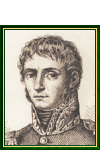

"Charles Victor Emmanuel Leclerc (1772-1802)". Print of the nineteenth century.
Authors


Didier Grau
Lionel A. Bouchon
This page was written by Didier Grau, Doctor of Medicine, 13008 Marseille, France and Lionel A. Bouchon, Pharmacist, IT specialist. 74540 Gruffy. France. The two of them founded the Napoléon et Empire website in 2008 and have run it together ever since. Their research focuses in particular on the precise location of Napoleonic sites of memory.
About this page
Published on: September 18th, 2013
Reading time: Between 3 and 5 minutes.
Last modified on: November 21st, 2025
Word count: 786
Number of images: 1