Siege of Genoa
The defense of Genoa [Genova] by General André Masséna was a strategic success despite the city's eventual evacuation. The garrison's tenacious resistance pinned down significant Austrian forces just as the reserve army, led by First Consul Napoleon Bonaparte, crossed the Alps to attack the enemy's rear. This feat of arms played a decisive role in the success of the battle of Marengo and, consequently, in the Second Italian Campaign.
Date and place
- From April 20 to June 4, 1800, in Genoa, Liguria.
Involved forces
- French army (18,000 men) commanded by General André Masséna.
- Imperial Austrian Army (approximately 24,000 men) under the command of Field Marshal-Lieutenant Peter Karl Ott von Bátorkéz; Royal Navy squadron commanded by George Keith Elphinstone.
Casualties and losses
- French Army: around 8,000 killed, wounded, or missing.
- Austrian Army: approximately 6,000 killed, wounded, missing, or captured.
Context
Upon Napoleon Bonaparte's rise to power as First Consul following the coup of 18 Brumaire, Year VIII, the French military situation in Italy was in a rather precarious state. The victories of the Austro-Russian forces under Alexander Vasilyevich Suvorov (Алекса́ндр Васи́льевич Суво́ров) over Jean-Victor Marie Moreau at Cassano on April 27, 1799, over Etienne Macdonald at La Trebbia on June 17, 18, and 19, and over Barthélémy Catherine Joubert at Novi on August 15, confined French troops to a narrow strip of land along the Mediterranean coast, between Genoa and the border of the Var department.
The Army of Italy, commanded by Masséna since November 23, 1799, not only saw its territory shrink dramatically but also lacked everything: food, clothing, and ammunition. Its mission, however, was to hold and tie down as many Austrian troops as possible in order to facilitate the French offensive being prepared in Germany and Northern Italy.
Forces involved
In April 1800, Masséna organized his forces into three corps to hold Liguria and manage the shortage of soldiers. Disease was decimating his units, often reducing them to skeletal numbers.
The right wing was commanded by Nicolas Jean-de-Dieu Soult and numbered around twenty thousand men. It comprised three divisions, respectively led by Sextius Miollis , Honoré Gazan , and Jean-Antoine Marbot . Its mission was the defense of Genoa and the Bocchetta Pass [44.55068, 8.88782], 23 kilometers to the north, leading into Piedmont;
The center was placed under the command of Louis-Gabriel Suchet, who had four divisions totaling 15,000 to 16,000 men to cover Savona[Savona] , 48 kilometers to the west on the Ligurian coast, and to maintain the link between Genoa and the Var region.
The left wing was under the command of Louis-Marie Turreau . With a division of 8,000 men, he defended the Mont Cenis Pass and the Alpine valleys.
In Genoa itself, command was entrusted to General Sextius Miollis. He had cosmopolitan units at his disposal, including the 2nd Polish Legion.
Facing them, Field Marshal Michael Friedrich Benedikt von Melas led a powerful (62,000 men) and well-supplied Austrian army. It was also supported by the Royal Navy, which had established a naval blockade under the command of Admiral George Elphinstone, 1st Viscount Keith . A flotilla of Neapolitan gunboats would reinforce its squadron on May 7.
Austrian Plan
At the start of the spring 1800 campaign, the Austrians aimed to fragment the Army of Italy. They intended to isolate its right flank in Genoa and push its left flank back beyond the Var River (which then served as the eastern border of the department of the same name), before invading Provence, capturing Toulon, and thereby causing the collapse of the new regime. The Austrian plan of operations was justified by the extreme fragmentation of the Army of Italy, imposed on Masséna by the terrain.
Preliminary Operations (April 5-19)
The Austrian army launched its offensive on April 5, 1800. Melas divided his forces into three columns to envelop the French positions.
At Cadibona (10 kilometers north-northwest of Savona), on the 6th, Field Marshal Lieutenant Karl Joseph Hadik von Futak , at the head of 13,000 men, attacked the division of Jean-Antoine Marbot (3rd Division of the French right wing), which could only muster 3,000 soldiers. Despite a stubborn resistance, the French were routed. Brigadier General Jean-Mathieu Seras was captured. Communications with Suchet were definitively severed.
As planned, the Austrians succeeded in splitting the Army of Italy in two. Masséna and Soult, trapped in the east, entrenched themselves in Genoa. Suchet was forced to retreat westward and had to abandon Savona.
Simultaneously, the column of Field Marshal-Lieutenant Peter Karl Ott von Bátorkéz , descending the Trebbia Valley with 8,000 men, blocked all exits to the east, while Prince Friedrich Franz Xaver von Hohenzollern-Hechingen threatened the Bocchetta Pass north of Genoa.
To counter this critical situation, Masséna, with his customary audacity, attempted a sortie as early as April 7. A column of 5,000 men, drawn from the Genoa garrison, attacked Ott's positions on Monte Fasce [44.40942, 9.03417], 11 kilometers to the east. The maneuver was successful. The French captured 1,400 Austrians and pushed back the enemy line.
However, this tactical advantage was not enough to reverse the overall tide. In the west, fighting continued at Sassello [44.47898, 8.49020] on April 10, as well as at Monte Settepani [44.24599, 8.19823] that same day and the following day. Suchet managed to capture 1,200 Austrians there, but he was ultimately overwhelmed by sheer numbers when reinforcements brought by Anton von Elsnitz solidified the Austrian superiority.
On April 19, Melas considered Masséna trapped in Genoa. He then entrusted the command of the siege to Ott, assigning him 24,000 men. Melas himself marched west with 28,000 soldiers to finish off Suchet.
The Siege of Genoa
Topography
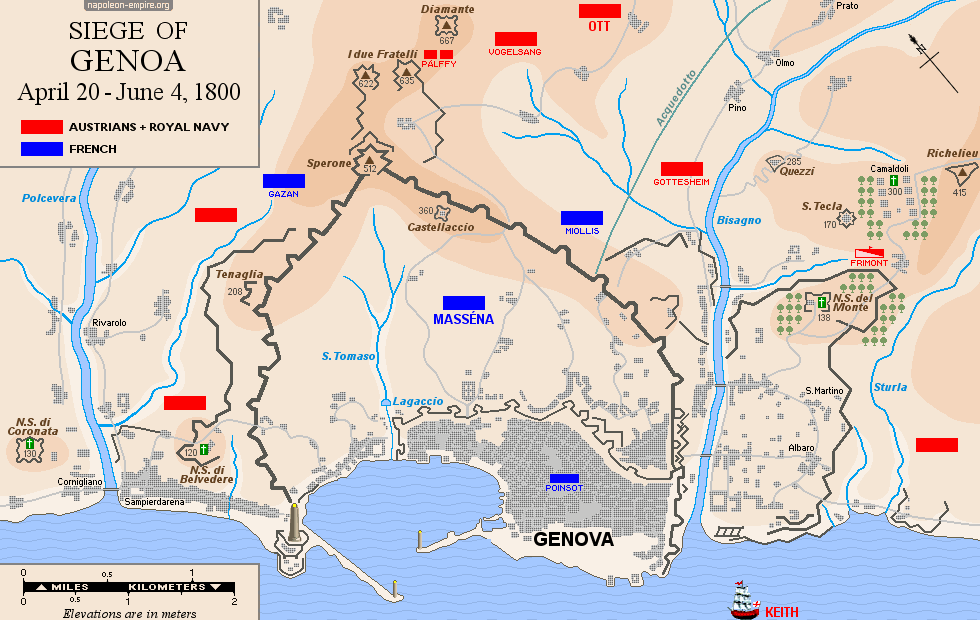
The city of Genoa then appeared to be one of the most secure fortresses. The city, surrounded to the north by a mountainous amphitheater, was protected by two successive lines of defense. The Old Walls encircled the city center, while the New Walls (Mura Nuove), dating from the 17th century, followed the crests of the surrounding hills. They extended for a perimeter of about twenty kilometers.
The high points outside the walls were crowned with forts that formed veritable strongholds:
Fort Sperone [44.44057, 8.93040]. It was located at the apex of the defensive triangle and commanded the two main valleys, the Polcevera to the west and the Bisagno to the east, which surrounded the city.
Fort Diamante [44.46123, 8.93946]. At 670 meters above sea level, north of the city, it was the most exposed advanced bastion. It monitored approaches from Piedmont.
Fort Richelieu [44.42131, 8.99155]. At an altitude of 415 meters. It was named after Marshal Armand du Plessis de Richelieu, who defended the city during the siege of 1746-47. The fortification stood on the eastern ridge and protected the Bisagno Valley from an attack coming from the east.
The Two Brothers (Fratello Minore [44.44057, 8.93039] and Fratello Maggiore [44.45656, 8.93628]). Located between Fort Sperone and Fort Diamante, which they prevented from being besieged, these were two twin redoubts (Little Brother and Big Brother).
Organization of Forces
The besieged's ability to hold these positions determined their resistance. If the Austrians were to capture Monte Peraldo (on which Fort Sperone stands), their artillery would be able to bombard Genoa with devastating accuracy.
Consequently, General Masséna devoted the first day of the siege, April 20, to visiting all these outposts, accompanied by the commanders of the engineers (Battalion Commander Louis Marès) and the artillery (General Jean Fabre de La Martillière), in order to order all necessary repairs and review the battery placement.
Finally, he reorganized the forces remaining at his immediate disposal, namely those that had hitherto constituted the right wing of the Army of Italy, dividing them into two divisions and a reserve:
Miollis Division. It comprised 4,500 troops and was deployed from the sea to the Due Fratelli (Two Fratelli) on the eastern flank;
Gazan Division. It numbered 3,500 soldiers and covered the western flank of the line;
Reserve. His 1,600 soldiers, under the command of General Pierre Poinsot de Chansac, were positioned within the city itself.
The Austrian army, for its part, was organizing itself for the blockade. General Ott was assisted by Field Marshal-Lieutenant Ludwig von Vogelsang , in charge of the northern sectors, and Major General Friedrich Heinrich von Gottesheim, commanding the vanguard and reconnaissance units.
Beginning of the Siege of Genoa
On April 20, the siege proper began. British Admiral Keith deployed his fleet (the ship Minotaur, the frigates Phaeton, Mondovi, and Phoenix, the cutter Entreprenante, and the supply ship Victoire) to prevent any relief by sea. The ships also engaged in bombardments that targeted not only the coastal batteries but also dealt a severe blow to the morale of the civilian population.
Masséna retaliated by firing red-hot cannonballs at the British ships, sometimes forcing them to retreat. Simultaneously, as early as the 24th, he informed the First Consul that Genoa could not hope to hold out for more than ten or fifteen days due to a lack of supplies.
Attempted Austrian General Assault
On April 30, 1800, Ott attempted to hasten the outcome by launching a general assault. The attack began before dawn, supported by the British fleet in the form of a massive bombardment. Major General Nikolaus Pálffy ab Erdöd launched an assault on the Two Brothers redoubt with two infantry regiments. The Austrians captured it.
Simultaneously, Cavalry Colonel Johann Maria Philipp Frimont seized advanced positions to the east. If he were to capture Madonna del Monte [44.41303, 8.96388], the Austrians could bombard Genoa from there, and the city's situation would become desperate.
Masséna, displaying the composure in the face of adversity for which he was renowned, immediately organized a counter-attack with the remnants of Gazan's division. At the cost of fierce fighting, the French recaptured all the positions they had previously lost. The Austrians lost over 3,000 men that day, the French around 1,500.
This defeat convinced Ott that only starvation could break Masséna's resistance.
May: Famine, Disease, and Survivors
For the besieged, May 1800 proved extremely difficult. The city suffered bombardments and famine. Bread rations—made from starch, flaxseed, cocoa, and straw—became increasingly meager. Cavalry horses, then domestic animals, and finally rats appeared successively on the menu before disappearing one after the other.
Nearly 30,000 civilians died of hunger and typhus, out of a total population estimated, according to various sources, between 70,000 and 160,000.
Austrian prisoners, held on prison hulks, gnawed at the ropes before resorting to cannibalism. The Austrian command refused to provide the provisions Masséna requested for them. The French commander-in-chief therefore practically ceased feeding them, preferring to reserve the meager supplies he had for his own troops.
On May 5, a small boat managed to break through the British blockade, bringing five days' worth of rations and a brief improvement in conditions.
The capture of General Soult (May 13, 1800)
Masséna, hoping for intervention from Bonaparte or Suchet, ordered a major sortie on May 13 to try to lift the blockade on the northern flank. The fighting began in torrential rain. General Soult led the attack towards Monte Creto [col at 44.47215, 9.00896]. While leading his troops, a bullet shattered his right leg. Unable to be evacuated, he was captured by the Austrians.
The loss was significant. Soult was Masséna's right-hand man. Masséna found himself alone in directing operations and maintaining order among a population consumed by despair and increasingly tempted by revolt (cannons had to be installed in the streets on May 29th to prevent riots). From the day of this capture, sorties became less frequent and were limited to seizing supplies from enemy outposts.
On the 14th, a message from the First Consul, delivered by Squadron Leader Jean-Baptiste Franceschi-Delonne , who had managed to cross the English fleet's lines by boat and then by swimming, announced his entry into the campaign. Masséna had it translated, printed, and distributed everywhere to galvanize the troops and restore the population's morale.
On the 20th, another dispatch offered hope for the city's relief before the end of the month, restoring a measure of courage and energy to the exhausted defenders.
The relief would come somewhat later, but it would indeed come from the movements of the reserve army, which crossed the Great St. Bernard Pass between May 15 and 23. On June 2, Bonaparte entered Milan, threatening Melas's lines of retreat towards Austria.
Melas, having anticipated the danger, ordered Ott on May 27 to lift the siege of Genoa and join him immediately in Alessandria. Ott received this order on June 2. However, convinced that Genoa was at the end of its tether, since Masséna had just agreed to the principle of negotiations, he granted himself a two-day delay to secure the city's surrender, hoping to capture it before leaving.
The Convention of Genoa
On June 1st, Masséna, with only a few days' worth of rations left and seeing his soldiers starving, finally resigned himself to negotiations. The talks opened in an atmosphere of extreme tension. Despite his desperate situation, Masséna, with breathtaking audacity, laid down his conditions. He refused to allow the word "capitulation" to appear in the convention and demanded that his troops leave with the honors of war.
On June 4, 1800, in the tiny chapel on the Cornigliano bridge [44.41555, 8.87980], the Convention of Genoa was signed between the French, the Austrians, and the British.
It stipulated that the 8,000 able-bodied French soldiers would return to their country along the coast with "arms and baggage." Masséna himself and his staff would embark for Antibes on privateer ships. The sick and wounded (approximately 16,000) remained under Austrian guard until the Royal Navy evacuated them to France.
On June 5, Austrian troops entered a devastated city. Masséna had successfully managed to hold Ott's corps for over two months outside Genoa.
Outcome and Consequences
Of the 7,000 to 8,000 French soldiers who left Genoa on foot, more than 6,000 were deemed unfit for combat upon their return to France.
Estimates of losses vary considerably depending on the source. For the French army, they range from 8,000 to 14,000 dead, wounded, or missing, in addition to 6,000 sick. The Austrian army lost between 6,000 and 20,000 men. Finally, between 15,000 and 30,000 civilian casualties were added to this toll.
Once the siege was lifted, Ott marched on Alexandria [Alessandria] . He clashed with the French vanguard at Montebello and then participated in the battle of Marengo. However, his prolonged standoff before Genoa deprived the Austrians of the forces necessary to counter the First Consul's offensive in a timely manner.
Map of the siege of Genoa
 Display the map of the Second campaign in Italy (1800)
 The Italian Campaign of 1800 day by day
Photos Credits
Photos by Lionel A. Bouchon.Photos by Marie-Albe Grau.
Photos by Floriane Grau.
Photos by Michèle Grau-Ghelardi.
Photos by Didier Grau.
Photos made by people outside the Napoleon & Empire association.