The Council of State
 List of Members of the Council of State.
The Council of State is a body established by the Constitution of Year VIII and, in order of precedence, ranks second in the State, immediately after the senatorSenate. It shares with the later, the Legislative Body, and the Tribunate the privilege of receiving the oath of the Head of State upon assuming office. It also enjoys certain legal privileges, and the salaries granted to its members are generous: 25,000 francs per year for councilors, 30,000 francs per year for section presidents, not counting the additional bonuses of 10,000 to 15,000 francs with which Napoleon was not stingy.
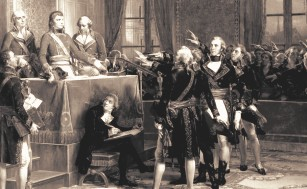

Although its opinions were only advisory, the role of the Council of State was considerable. It actively participated, often under the presidency of Napoleon himself, in the development of administrative reforms that transformed the economic, political, and social organization of Europe; all the codes that brought glory to the regime were examined or drafted there; on several occasions, Napoleon changed his opinion under its influence.
Organization
The members of the council held the title of Councillors of State. They were appointed and could be dismissed by the First Consul and later the Emperor, but during the Napoleonic era, there were only two dismissals: that of Nicolas Frochot and that of Joseph Marie Portalis (the son of Jean-Étienne-Marie Portalis, Minister of Religious Affairs from 1804 to 1807). The council was divided into five sections: a finance section, a civil and criminal legislation section, a war section, a naval section, and an interior section. Each was chaired by a councilor appointed annually by the First Consul and later the Emperor.
The councilors appointed on 4 Nivôse, Year VIII (January 22, 1800) numbered twenty-nine. By the end of Year VIII, there would be forty. Their selection reflected a wide range of political views. Among them were former Feuillants such as Claude-Ambroise Regnier and Michel Regnaud de Saint-Jean d'Angély; Royalists like Jean Devaisne and Bertrand Dufresne; Jacobins like Guillaume Brune and Pierre-François Réal. The First Consul wanted to prioritize competence, especially legal competence, and stability.
The decree of 7 Fructidor, Year VIII (August 27, 1800) divided the councilors into two categories: those who worked in Paris within the Council and those who were assigned to other administrations, either permanently or for a temporary mission. The former were designated as serving in ordinary service, the latter in extraordinary service. Among the latter, some would serve as prefects, others would accompany the armies on campaign, or would be responsible for the administrative reorganization of annexed territories.
In 1803, a decree established the auditors: these were younger members who came to the Council to receive training. In 1806, the Masters of Requests appeared, hierarchically positioned between the auditors and the Councilors of State themselves. All can serve in ordinary or extraordinary capacity. This structure makes the Council of State a training ground for administrators destined for brilliant careers: the majority of ministers appointed after 1800 came from the Council of State: François de Barbé-Marbois, Jean-François-Aimé Dejean, Claude-Ambroise Regnier, Jean-Étienne-Marie Portalis, Jean-Baptiste de Nompère de Champagny, Nicolas-François Mollien, Henri-Jacques-Guillaume Clarke, Emmanuel Crétet, Félix Bigot de Préameneu, Jean-Pierre Bachasson de Montalivet, Jean-Gérard Lacuée, Pierre-Antoine Daru, and Mathieu Molé.
Napoleon, wishing to open the Council to representatives of the annexed regions, appointed six Italians (Pierre Galli Della Loggia, Antoine Asinari Saint-Marsan, Louis Corvetto, Joseph Giunti, Marie-Joseph Néri Corsini, and Vincenzo Bartolucci), one from the Rhineland (Gérard Deloë), four Dutchmen (Jean-Henri Appelius, Cornelis Felix Van Maanen, Isaac Gogel, and Paulus Van der Heim), and one German (Emmerich Dalberg) as Councillors of State from 1802 to 1811.
Missions
During the Consulate and the Empire, the Council of State fulfilled three roles: legislative, administrative, and judicial.
Legislative role
The legislative role of the Council of State derives from Article 52 of the Constitution – Under the direction of the consuls, a Council of State is responsible for drafting bills and regulations for public administration... – but in practice it is much broader than it provides for and even greater than that of the Legislative Body.
Drafting and Presentation of Bills to the Legislative Body
The Council of State's role in drafting legislation is not limited to the purely technical function described in Article 52. In practice, the government also consults it on the political and social content of the texts it is tasked with drafting. The Constitution, which prohibits both the Tribunate and the Legislative Body from amending laws submitted to their vote, explains this recourse to an administrative body but also alters its nature by considerably amplifying its influence. Furthermore, the Council of State does not merely prepare laws; it also participates in the drafting of certain senatus consulta, regulations, decrees, and orders. Only the texts of treaties are not submitted to it.
Once the bill is drafted, the Constitution (Article 53) entrusts the Council of State with the task of presenting it to the Legislative Body. One to three members of the Council are chosen by the government for this purpose.
The Council's Opinions
The Council of State also intervened in the interpretation of the law by issuing opinions, in accordance with Article 11 of the regulation of 5 Nivôse, Year VIII (December 26, 1799): the Council of State elaborated on the meaning of laws based on questions referred to it by the Consuls
. These opinions, when approved by Napoleon — which was not always the case — were published and thus acquired the force of law, a fact upheld by the Court of Cassation during the Consulate.
Drafting of Codes
However, the best-known aspect of the Council of State's legislative activity was the drafting of the five major Napoleonic codes: the Civil Code (1804), the Code of Civil Procedure (1806), the Commercial Code (1807), the Code of Criminal Procedure (1808), and the Penal Code (1810).
All of them integrate into a unified whole the old rules and the new principles upon which the society born of the Revolution was founded. The Civil Code, the most remarkable of all, is the one in whose drafting Napoleon took the greatest interest. After the initial review by the Legislation Section, the First Consul personally presided over fifty-seven of the one hundred and two sessions of the Council of State convened in general assembly, which were necessary for its creation. The French Civil Code was published on March 21, 1804. This work, which the deposed Emperor would still affirm in 1818 as the surest foundation of his future glory, quickly garnered general approval — a testament to the vision of its drafters.
The other codes were also prepared by the Legislation Section, but Napoleon himself was much less involved in their drafting.
Administrative Role
The Council of State's powers in this area were numerous.
It drafts the texts regulating the application of laws and decrees; appeals for abuses in ecclesiastical matters are submitted to it, in accordance with the Organic Articles of the Concordat; a decree of June 11, 1806, grants it the right to intervene in high-level administrative policing, as it can examine the conduct of an official with a view to proposing criminal proceedings or administrative sanctions. Furthermore, the Emperor sometimes extends the Council's jurisdiction to the operation of numerous public services on his own authority. For example, the budgets of the Dutch, Illyrian, and Hanseatic municipalities, when exceeding 20,000 francs, must be reviewed by the Interior Section.
Legal Role
The Constitution of Year VIII, as clarified by the regulation of 5 Nivôse, Year VIII, entrusted the Council of State with the responsibility of ruling on jurisdictional disputes between the ordinary courts and the administration concerning litigation between public and private entities, as well as on contentious matters whose decision was previously referred to the Minister. In both cases, the Council acts after referral by the Consuls and then by the Emperor.
The Council of State also hears appeals in cases of departmental administrative disputes. It also examines appeals against decisions rendered by the Maritime Prize Court and (after 1807) the Court of Auditors. It is not required to provide reasons for its decisions. Referral to the Council falls under the authority of the Head of State. Judgments are rendered under the authority of the Head of State, although he does not participate in the judgment and reserves the right to disregard it.
During the Consulate and the Empire, the judicial role of the Council of State represented only a small part of its activity. This did not, however, prevent the creation of a litigation commission, which examined disputes before the council's deliberations and to which a private individual could directly address their appeal.