Battle of Smolensk
print "
The Battle of Smolensk [Смоленск] was the first major engagement of the French invasion of Russia. The Grande Armée captured the city after fierce fighting but could not halt the Russian army's retreat. Despite the victory, Napoleon I had still not achieved the decisive success he had been pursuing for over six weeks.
";Date and place
- August 16th and 17th (August 4th and 5th in the Julian calendar, used in Russia)
Involved forces
The General Situation
Since setting foot on Russian soil on June 25, 1812, Napoleon and the Grande Armée had been exhausting themselves in a relentless pursuit of the retreating Russian army.
No maneuver could force the commander-in-chief of the latter, Mikhail Bogdanovich Barclay de Tolly (Михаи́л Богда́нович Баркла́й-де-То́лли), to gamble the fate of the war in a major battle. This caution earned him the hostility of most of his subordinates and of General Pyotr Ivanovich Bagration (Пётр Иванович Багратионv), who also challenged his authority.
By pushing much deeper into enemy territory than anticipated, the French eventually approached Smolensk, a strategic fortified position controlling the road to Moscow. The 1st and 2nd Russian Armies of the West, respectively commanded by Barclay de Tolly and Bagration, concentrated there, with Napoleon's blessing, who hoped that, thus united, they would accept the confrontation. The Russians were positioned in front of the city, on the north bank of the Dnieper. They expected the French to advance directly from Vitebsk [Віцебск] [55.19269, 30.20619].
The Emperor, on the contrary, devised a maneuver intended to surprise his adversaries. The bulk of his forces joined up with those of Louis-Nicolas Davout, and the combined force crossed to the left bank of the Dnieper on August 13 at Rasasna [Расасна] [54.64760, 30.87402], 80 kilometers downstream from Smolensk. The Grande Armée then marched on the city to attack the Russians in their rear.
But the next day, it encountered the garrison left by Barclay in the city of Krasnoye [Красный] [54.56663, 31.43651]. General Dmitri Petrovich Neverovsky's division was indeed dislodged, but it managed to retreat. The element of surprise was lost.
On the 16th, the French vanguard appeared before the city.
Strengths
Napoleon had assembled approximately 180,000 men, including Joachim Murat's cavalry and the corps of Michel Ney, Davout, and Prince Eugène de Beauharnais.
The Russians had 140,000 combatants, divided between the 1st and 2nd armies.
However, the belligerents would only commit a fraction of their respective forces to the battle.
Topography
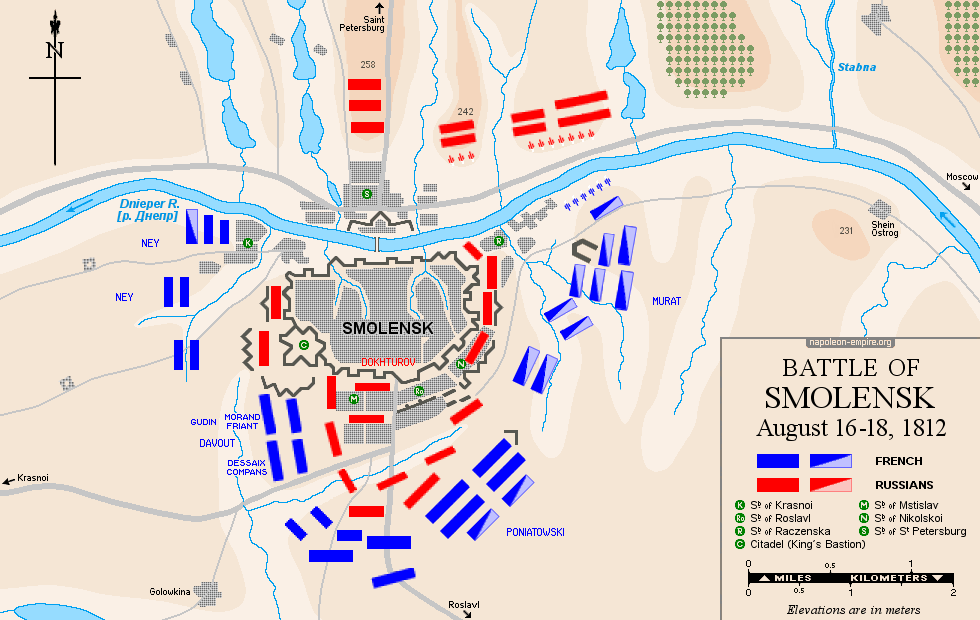
The city of Smolensk [54.789796, 32.05042] had approximately 20,000 inhabitants. It stood on the left (southern) bank of the Dnieper River [Дняпро]. Its fortified walls, five meters high and about twelve meters thick, included twenty-nine towers. These walls had a breach, known as the Nicholas Breach, defended by an earthwork, the King's Bastion, equipped with artillery. Outside the ramparts, several suburbs surrounded the city. These were, from west to east, the suburbs of Krasnoy, Mstislav, Roslavl, Nikolskoy, and Raczenska. The last, the suburb of Saint Petersburg, was located on the right (northern) bank of the river. It was connected to the city by a bridge whose approach was protected on this side by a hornwork.
The terrain was quite rugged, and plateaus overlooked the city on both banks.
Weather Conditions
The weather remained fine for two days.
Initial Positions on August 16
Upon the arrival of the French, the city was defended by the corps of Nikolai Nikolaevich Raevsky and Neverovsky's division. The southern suburbs, the King's Bastion, and the bridge were garrisoned with troops. Part of the Russian cavalry was positioned on the left bank upstream from Smolensk.
On the French side, Murat's cavalry, of little use in the situation, arrived shortly before Ney, who appeared at 8:00 a.m. before the Krasnoy suburb, west of the city. He was joined at 4:00 PM by Charles Étienne Gudin's division, which positioned itself on his right.
Fighting of August 16th
Barely arrived, Ney attacked. The III Corps deployed: François Roch Ledru des Essarts' division in the lead, Louis Nicolas' (sometimes called Jean Nicolas) Razout's division in support, and the Corps' cavalry brigade between the two. Their right flank was positioned along the Krasnoy road. The Württemberg division held its position behind and on the left.
The entire force numbered only 18,000 men. The chances of them succeeding in capturing a well-guarded city were slim. It was more of a raid intended to prepare for the attack the following day.
Ney did, however, manage to temporarily dislodge the Russians from the Krasnoy suburb. But he was soon forced to retreat in the face of a sortie by the garrison, just as he failed to capture the king's stronghold.
The fighting continued in vain until 5:00 PM. The arrival of Gudin an hour earlier had not significantly altered the situation.
Battles of August 17
New Russian dispositions
Barclay wanted to prevent the Grande Armée from interposing itself between him and Moscow at all costs. If it succeeded, a general battle would become inevitable, unless the Russian armies retreat towards Saint Petersburg. But this last option could only be a last resort because of its foreseeable consequences: a fall in morale, loss of any ability to maneuver jointly with the armies of Alexander Petrovich Tormasov (Алекса́ндр Петро́вич Торма́сов) and Pavel Vasilievich Chichagov (Па́вел Васи́льевич Чича́гов), both operating in the south. The Russian commander-in-chief therefore decided that the 1st Army would occupy Smolensk and the right bank of the Dnieper River while the 2nd Army withdrew to Dorogobuzh Дорогобуж]. Once the 2nd Army had crossed to the other side of the Dnieper, the 1st Army would follow suit.
The corps of Dmitri Sergeyevich Dokhturov , reinforced by two divisions taken from the corps of Raevsky and Nikolai Alekseyevich Tuchkov , established three divisions in the southern suburbs of Smolensk and the King's Bastion. A final division was held in reserve behind the Malakhov Gate (southeast).
French dispositions
Napoleon still intended to force the Russians into battle on the right bank of the river. The idea of crossing upstream from the city was considered and rejected. He therefore had to take Smolensk very quickly, cross the river, and prevent Barclay from escaping. Furthermore, control of the city was essential to secure French communications.
The French units were deployed as follows:
- on the left, Ney's Corps, with Ledru's Division and the Württemberg Division in the first line, and Razout's Division in the second;
- in the center, Davout's Corps, with the divisions of Gudin, Charles Antoine Louis Alexis Morand , and Louis Friant in the lead, followed by the divisions of Jean-Dominique Compans and Joseph Marie Dessaix ;
- on the right, Józef Antoni Poniatowski's Corps, composed of the divisions of Józef Zajączek and Ludwik Kamieniecki;
- on the far right, Murat's cavalry reserve served only to extend the line of defense to the Dnieper River;
- in the rear, Prince Eugene's corps guarded the lines of communication and observed both banks of the river.
The Fighting
The morning was spent in inconclusive skirmishes. A few skirmishes to the west yielded no results. In the center, a reconnaissance ordered by Gudin, followed by the engagement of several regiments, ended in a retreat.
Around 1 p.m., the confrontation took on a new dimension.
On the left, the Württemberg brigades of Ernst Eugen von Hügel and Ludwig Friedrich von Stockmayer entered the Krasnoy suburb under fire from Russian artillery. They established themselves in the cemetery, from which no one could dislodge them. At the same time, Ledru's division cautiously attacked the King's Bastion, which had resisted them the previous day.
In the center, the divisions of Gudin (including Davout), Morand, and Friant launched a frontal assault on the suburbs of Mstislaw and Roslavl. Dessaix's division formed a second line of defense behind them, while Compans's division remained in reserve on the plateau. Gudin, Morand, and Friant all reached the city walls but failed to breach them. Despite the Emperor's order to concentrate the fire of 36 twelve-pounder cannons on the ramparts, it proved impossible to breach the fortifications.
On the right, after an artillery duel, Poniatowski attacked the suburb of Nikolskoy and the Malakhov Gate. The divisions of Zayonchek and Kamienicki, with a 60-gun battery operating between them, dislodged the Russians from the suburb and drove them back into the city. Part of the regiments then advanced on the Malakhov Gate and the King's Bastion, while the other seized the Raczenska suburb. But on this side as well, the wall's strength thwarted any attempts to breach the ramparts. The Polish artillerymen were forced to retreat under Russian fire.
On the far right, the Russian cavalry had to take refuge in the fortress under pressure from Emmanuel de Grouchy's cavalry. He was monitoring the Dnieper River upstream while his corps' artillery bombarded the enemy cannons on the right bank of the Dnieper.
Several districts of the city experienced fires during the afternoon. Whether caused by bombardments from French batteries or deliberately set by the Russians, they engulfed Smolensk in smoke, making the defenders' task easier.
At the end of the day, the Russians still held Smolensk, despite some very close calls, particularly at the Malakhov Gate. An additional division had to be brought in to reinforce Dokthurov's position at the most critical points.
Losses were very high in the Polish Corps, as well as in the Gudin and Württemberg divisions.

Russian Evacuation
During the night of August 17-18, the defenders of Smolensk abandoned the city, setting fire to several districts to cover their retreat, crossed the Dnieper River, and destroyed the bridge behind them.
Meanwhile, the Russian army retreated eastward.

The French occupied the city on the morning of the 18th, but found only ashes and ruins. The expected resources were lacking.
Toll
The number of casualties varies depending on the source.
It seems certain, however, that it exceeded 10,000 men on each side, if we include the killed, wounded, missing, and prisoners.
Consequences
Tactically, the victory went to the French. Strategically, however, they did not achieve their objective of forcing the Russians into a large-scale battle. The Russians withdrew in good order, and their forces were undamaged. It was therefore a failure for Napoleon.
Especially since, on the 19th, at Valutino-Gora, the Grande Armée once again missed the opportunity to inflict a serious, even decisive, defeat on the enemy, and settled for a victory that would lead nowhere.
General Barclay de Tolly, already facing criticism before these events, saw the censure intensify after the loss of Smolensk and the near-rout at Valutina-Gora. On the 20th, he relinquished his position to Marshal Mikhail Illarionovich Golenishchev-Kutuzov (Михаил Илларионович Голенищев-Кутузов).
Russian order of battle
| First Army West | General of Infantry Mikhail Bogdanovich Barclay de Tolly | II Infantry Corps | Lieutenant general Karl Gustav Baggovut | 4th Division | General Major Prince Eugene von Würrtemberg |
| 17th Division | Lieutenant general Zakhar Dmitrievich Olsufiev | ||||
| Cavalry | General Major Alexey Matveevich Vsevolozhsky | ||||
| III Infantry Corps | Lieutenant general Nikolay Alexeyevich Tuchkov | 1st Grenadier Division | General Major Pavel Alexandrovich Stroganov | ||
| 3rd Division | Lieutenant general Pyotr Petrovich Konovnitsyn | ||||
| Cavalry | General Major Vasily Vasilyevich Orlov-Denisov | ||||
| IV Infantry Corps | Lieutenant general Alexander Ivanovich Ostermann-Tolstoy | 11th Division | General Major Pavel Nikolaevich Choglokov[ | ||
| 23rd Division | General Major Alexey Nikolaevich Bakhmetyev | ||||
| Cavalry | General Major Ivan Semyonovich Dorokhov | ||||
| V Infantry Corps | Grand Duke Konstantin Pavlovich | Guards Infantry Division | Lieutenant general Nikolai Ivanovich Lavrov | ||
| 1st united Grenadier Division | General Major Nikolai Nikolaevich Bakhmetyev | ||||
| 1st Cuirassier Division | General Major Nikolai Mikhailovich Borozdin | ||||
| Cavalry | General Major Nikolai Ivanovich Depreradovich | ||||
| VI Infantry Corps | General of the Infantry Dmitry Sergeyevich Dokhturov | 7th Division | Lieutenant general of Artillery Peter Mikhailovich Kaptzevich | ||
| 24th division | General Major Pyotr Gavrilovich Likhachev | ||||
| Cavalry | Général Cyprian Antonovich Kreutz | ||||
| Reserve Cavalry | I Reserve Cavalry Corps | Lieutenant general Fyodor Petrovich Uvarov[ | |||
| II Reserve Cavalry Corps | General Major Fyodor (Friedrich Nicholai Georg) Karlovich Korf | ||||
| III Reserve Cavalry Corps | General Major Pavel Petrovich Palen | ||||
| Cossack Corps | General of the Cavalry Matvey Ivanovich Platov | Second Army West | General of Infantry Pyotr Ivanovich Bagration | VII Infantry Corps | Lieutenant general Nikolai Nikolaevich Raevsky | 12th division | General Major Pyotr Mikhailovich Kolyubakin |
| 26th Division | General Major Ivan Fyodorovich Paskevich-Erevansky | ||||
| VIII Infantry Corps | Lieutenant general Mikhail Mikhailovich Borozdin | 2nd Grenadier Division | General Major Karl August Christian von Mecklenburg-Schwerin | ||
| General Gortchakov's Corps | Lieutenant general Andrei Ivanovich Gorchakov | 2nd united Grenadier Division | General Major Mikhail Semyonovich Vorontsov | ||
| 27th Division | General Major Dmitri Petrovich Neverovsky | ||||
| Cavalry of the 2nd Army West | Lieutenant general Dmitry Vladimirovich Golitsyn | IV Reserve Cavalry Corps | General Major Karl Karlovich Sievers | ||
| 2nd Cuirassier Division | General Major Karl Bogdanovich Knorring | ||||
| Cossack Division | General Major Akim Akimovich Karpov | ||||
French Order of battle
Only units that took an active part in the fighting are listed.
| I Corps | Marshal Davout | 1st Infantry Division | General Morand |
| 2nd Infantry Division | General Friant | ||
| 3rd Infantry Division | General Gudin | ||
| 4th Infantry Division | General Dessaix | ||
| 5th Infantry Division | General Compans | ||
| III Corps | Marshal Ney | 10th Infantry Division | General Ledru des Essarts |
| 11th Infantry Division | General Razout | ||
| 25th Würrtemberg Infantry Division | General Georg von Scheler | ||
| Light Cavalry Division | General August Friedrich Wilhelm von Wollwarth | ||
| V Corps | General Poniatowski | 16e Infantry Division | General Zajoncek |
| 18th Infantry Division | General Kamienicki | ||
| 20th light Cavalry Brigade | General Antoni Paweł Sułkowski | ||
| Cavalry Reserve | Joachim Murat | III Cavalry Corps | General Grouchy |
Calendrier
All dates on this page are in the Gregorian calendar (then twelve days ahead of the Julian calendar in use in Russia at that time).
Map of the battle of Smolensk
Picture - The Battle of Smolensk on August 5 (17) 1812 by Peter von Hess (1792–1871)

Photos Credits
Photos by Lionel A. Bouchon.Photos by Marie-Albe Grau.
Photos by Floriane Grau.
Photos by Michèle Grau-Ghelardi.
Photos by Didier Grau.
Photos made by people outside the Napoleon & Empire association.