Alessandro Giuseppe Antonio Anastasio Volta
Knight of the Légion d'Honneur, Count of the Empire
Pronunciation:
Alessandro Giuseppe Antonio Anastasio Volta was born in Como , then Austria, now Italy, on February 18, 1745, into a noble but impoverished family.
After studying in Rome, he became professor of physics at the Royal School in 1774, then professor at the University of Pavia in 1779.
From 1780 to 1783, he traveled in Germany, the Netherlands, England and France, where he collaborated with Antoine Lavoisier and Pierre-Simon Laplace. In 1792, he studied Luigi Galvani's experiments on the frog, recreated them identically and refuted their conclusions.
On March 20, 1800, in a letter to the President of the Royal Society, he published his invention of the electric battery. The battery consists of a column stacked with pairs of zinc-copper discs separated by a piece of cloth soaked in salt water. A few weeks later, two British chemists, William Nicholson and Anthony Carlisle, carried out the first electrolysis using Volta's electric cell.
He presented his battery to the Institut de France in November 1801, in the presence of the First Consul. The latter awarded him a gold medal and a pension; as Emperor, he appointed him Count in 1810 and Senator of the Kingdom of Lombardy.
Volta retired to his home town in 1819, where he died on March 5, 1827. He is buried in the Camnago Volta cemetery .
"Count Alessandro Volta". 19th century anonymous.

It was in his honor that the unit of electrical voltage was named "volt" in 1881.
In Como, a temple on the shores of Lake Como , inaugurated in 1928, houses a permanent exhibition dedicated to the scientist, while a toga statue by Francesco Durelli has been erected in the center of Piazza Volta.
Philately: The Italian Post Office has issued numerous stamps in honor of Alessandro Volta, such as the 0.20 Lire in 1927 to celebrate the centenary of his death.
Billetophilia: The Banca d'Italia issued a 10,000 lira banknote bearing Volta's effigy.
Other portraits
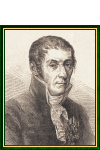

"Alessandro Volta". 19th century engraving.
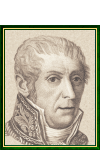
"Alessandro Volta". 20th century italian engraving.
Authors


Didier Grau
Lionel A. Bouchon
This page was written by Didier Grau, Doctor of Medicine, 13008 Marseille, France and Lionel A. Bouchon, Pharmacist, IT specialist. 74540 Gruffy. France. The two of them founded the Napoléon et Empire website in 2008 and have run it together ever since. Their research focuses in particular on the precise location of Napoleonic sites of memory.
About this page
Published on: September 18th, 2013
Reading time: Between 1 and 2 minutes.
Last modified on: December 2nd, 2024
Word count: 317
Number of images: 1