Adam Bajalics von Bajahaza
Baron (Freiherr)
Pronunciation:
Adam Bajalics was born in 1734 (exact date unknown) in Szeged, Hungary, into a Croatian family.
He first enlisted in the Austrian army in 1750, but abandoned service four years later. He re-enlisted in 1758, and remained in uniform until his retirement.
The Seven Years' War (1756-1763), which pitted France and Austria against Prussia and England, gave Bajalics the opportunity to earn his lieutenant's stripes in 1760. Captain-Lieutenant in 1768, then Captain in 1773, he was appointed Major during the conflict over the Bavarian succession (1778-1779), between Austria on the one hand, and Prussia, Saxony and Bavaria on the other.
In 1782, on September 10, he received the title of Baron von Bajahaza. His career continued at a steady pace: lieutenant-colonel in 1783, colonel in February 1789, to the benefit of the Austro-Turkish war of 1788-1791.
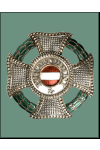
Bajalics became a general officer in the Upper Rhine army on January 1, 1794. He served under Dagobert Sigmund von Wurmser, later following him to Italy. After the battle of Handschuhsheim (September 24, 1795), in which the Austrians triumphed over the French, he was awarded the Military Order of Maria Theresa, the highest Austrian distinction for a man of war at the time.
His brigade was sent to northern Italy, starting in May 1796. The following year, Bajalics commanded a division at Rivoli, and this new responsibility was soon confirmed by the rank of Feldmarschall-Leutnant on March 1, 1797. During the Austrian retreat through the Julian Alps, Bajalics was part of the Austrian army's right wing. At its head, he found himself trapped in a valley between the André Masséna division occupying Tarvis [Tarvisio] and the division commanded by Jean Joseph Guieu, who had seized the Loïbl pass [Loiblpass, prelaz Ljublej] after passing through. He had no choice but to lay down his arms on March 23, 1797, with 3,000 men, 25 cannons and 500 baggage carts.
Bajalics left the service in 1797 and died on June 5, 1800 in Karlovac, Croatia.
His name is sometimes encountered as Adam Bajalić von Bajaházy, Adam von Bajalić Baja Hazy, or even Adam Bayalitsch.