Emmanuel de Launay, Count of Antraigues
Pronunciation:
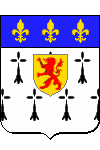
Emmanuel-Louis-Henri de Launay is said to belong to an old Vivarais family whose origins date back to the 14th century. He was born on December 25, 1753, either in Montpellier, Villeneuve-de-Berg or Antraigues-sur-Volane (sources differ on this point).
A cavalry officer under the Ancien-régime, he left the army for an unknown reason and began traveling. After criss-crossing Europe, he visited Syria, Egypt and even Ethiopia. These peregrinations enabled him to acquire a mastery of several languages and to forge useful relationships within European chancelleries.
In 1788, steeped in the doctrines in vogue (he had frequented Jean-Jacques Rousseau from 1770 until the philosopher's death in 1778, stayed in Ferney with Voltaire, frequented Sébastien-Roch Nicolas de Chamfort and Jean-François de La Harpe, Honoré-Gabriel Riqueti de Mirabeau), he published two pamphlets in which he showed himself to be very favorable to new ideas and the Third Estate, going so far as to write that Hereditary nobility is the greatest scourge that God, in his wrath, has poured out on mankind
.
Yet, the following year, it was this despised nobility that sent him to represent them at the Estates-General. At first, he showed himself to be a moderate revolutionary, voting for the Declaration of the Rights of Man, urging his order to renounce its privileges and taking part in the Oath of the Jeu de Paume. But the day of October 5, 1789, when the people of Paris went to Versailles to fetch the king and his family, turned him into an opponent of the new regime.
At the end of 1789, he was denounced for having planned the escape of the king and his family, in the company of the Marquis Thomas de Mahy de Favras. The execution of his presumed accomplice in February 1790 convinced him to emigrate the following month. He then entered the service of the Spanish government, for whom he carried out a number of more-or-less secret missions, a mixture of diplomacy, journalism and espionage.
During the occupation of Toulon by the British fleet, he obtained his appointment as "minister plenipotentiary" of King Charles IV of Spain to the "regent of France", the Count of Provence, who had expressed his intention to visit the city. As the future Louis XVIII's trip was not possible, d'Antraigues found another way to get in touch with him, and offered to set up an information office responsible for informing foreign courts about the internal state of France.
The proposal accepted, and the courts of Spain and England were soon inundated with bulletins conveying sensational news, which they nonetheless took seriously.
In 1797, d'Antraigues was installed in Italy, where, since the peace between France and Spain, he had belonged to the legation of the Russian Empire. After the capture of Milan, Napoleon Bonaparte, aware of his activities, had him arrested, seized his papers and had him write a memorandum revealing the treachery of general Charles Pichegru. Shortly afterwards, d'Antraigues, under house arrest but lightly guarded, fled in the company of his wife, the famous singer Antoinette Saint-Huberty, and his children.
Dismissed by the Count of Provence, whose suspicions had been aroused by his agent's easy escape, Count d'Antraigues took revenge by claiming to be in possession of papers written by Louis XVI just before his execution, denying the future Louis XVIII his right to the throne for having betrayed his own brother out of personal ambition.
D'Antraigues spent the following years in Germany, Austria and Russia, where he was appointed State Councillor and became Orthodox. Sent on a secret mission to Dresden by TsarAlexander I, he was expelled from Saxony in 1806 and settled in England. He made his living trafficking in documents, both real and forged - in 1807, he is said to have supplied Foreign Secretary George Canning with the secret articles of the Treaty of Tilsitt - occasionally blackmailing prominent figures.
Having lived by treachery, he logically died by treason. One of his servants - perhaps as the result of a sinister conspiracy involving one of the Earl's many enemies; perhaps out of fear of being discovered after selling compromising documents to Napoleonic agents; perhaps simply because he had been badly treated by his employers; murdered his master and his master's wife with a knife on July 22, 1812, in Barnes-Terrace, near London. The presumed culprit, named Lorenzo, is also found dead, from a pistol shot, in the home of his victims...
The Comte d'Antraigues left posterity an abundance of literary works: Mémoire sur les États généraux, leurs droits et la manière de les convoquer (1788), Ma conversation avec le comte de Montgaillard, Exposé de notre antique et seule règle de la constitution française, d'après nos lois fondamentales (1792), Mémoire sur la constitution des états de la province du Languedoc, Sur la régence de Louis-Stanislas Xavier (1793), Observations sur la conduite des princes coalisés (1795), then, during his long exile of twenty-two years, numerous pamphlets, first against the French Revolution, then against Napoleon: Des monstres ravagent partout, Point d'accommodement, Fragment de Polybe...
Address
27, Rue du Bac. Paris VIIème arrondissement
Address
27, Rue du Bac. Paris 7th arrondissement
The Count of Antraigues lived as a tenant in this building located at the corner of Rue du Bac and Rue de l'Université."Emmanuel-Louis-Henri of Launay, Count of Antraigues (possibly)". Miniature of the end of the eighteenth century.
